English
 日本語
日本語 한국어
한국어 Deutsch
Home > Author > Tang Ruihe — Regional Product Sales Manager > Three-Sided 3D Heater: A Smarter Approach to Comfortable Personal Heating
Content
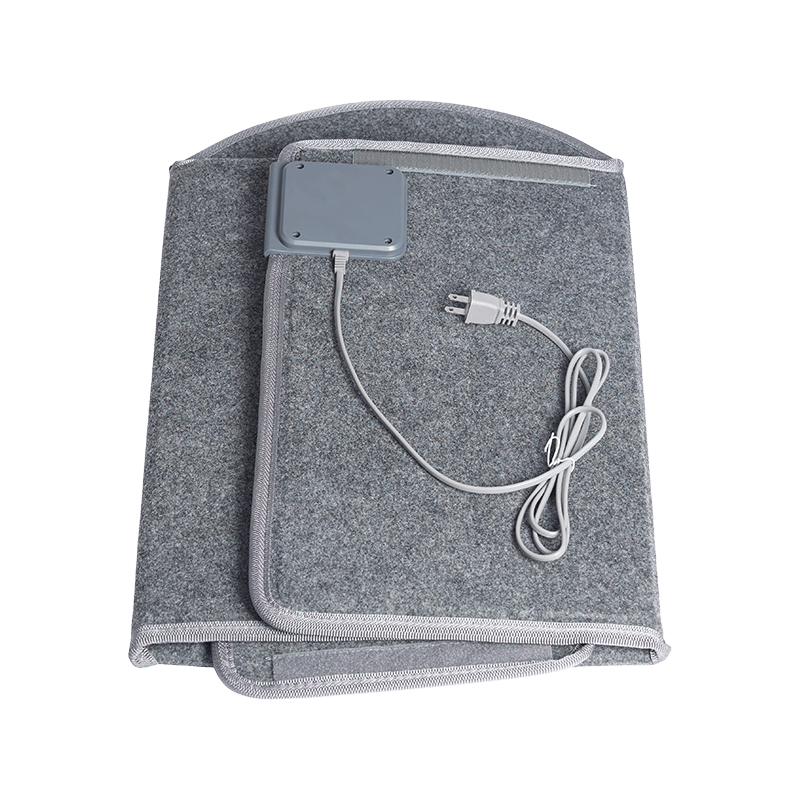
Personal heating has become increasingly important in homes, offices, bedrooms, study areas, and other indoor spaces where people need focused warmth rather than whole-room heating. Conventional heating systems can consume substantial energy when used to warm an entire room, while many compact heaters provide heat from only one direction. The Three-Sided 3D Heater addresses this limitation with a compact heating structure designed to surround the user with more balanced warmth.
Built for under-desk and personal heating applications, this 3D panel heater combines three-sided heat coverage, rapid warm-up, adjustable temperature settings, timer control, quiet operation, and multiple safety systems. Its 150W power rating is suitable for targeted warmth in smaller personal spaces, helping users remain comfortable without depending entirely on a central heating system or a high-power room heater.
The heater is identified as model MT-PH-001 and measures approximately 50 × 37 × 32 centimeters. Its structure is designed to fit around the lower body or beneath a desk while remaining compact enough for offices, bedrooms, study rooms, and other personal-use environments. The design also supports folding and space-saving storage, making it practical for seasonal use.
Most traditional portable heaters are based on a flat front-facing structure. Heat is projected primarily toward one direction, which means that the user may need to sit directly in front of the unit to feel its full effect. If the user moves slightly to one side, the warmth can become less noticeable. Furniture, desk panels, or other objects may also block part of the heated airflow.
The Three-Sided 3D Heater uses a different concept. Heating panels are arranged on three sides to create a more enclosed personal heating zone. Instead of concentrating warmth on one narrow path, the structure helps distribute heat around the legs and lower body. This can reduce the cold areas commonly experienced with one-sided heaters.
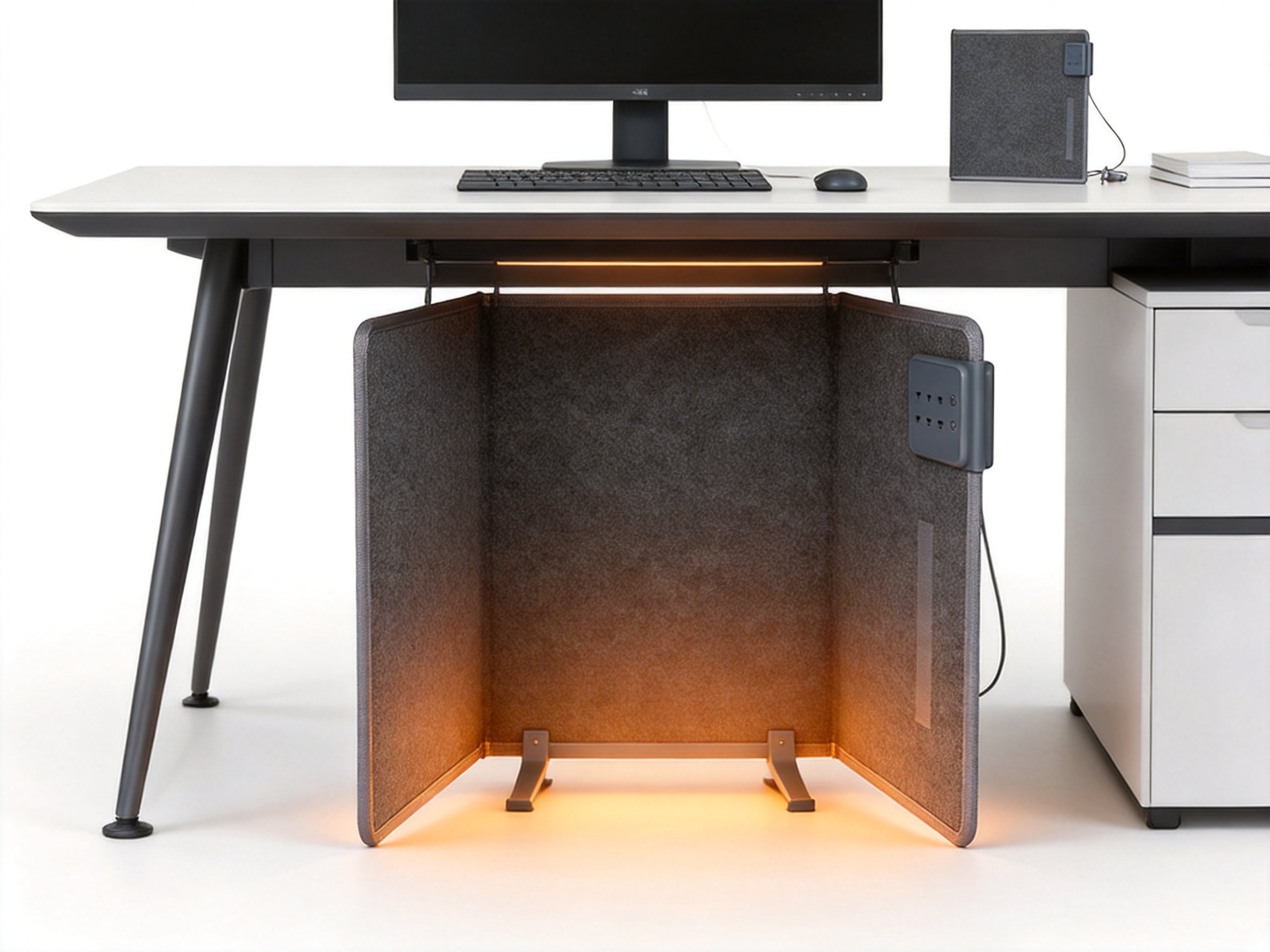
The surrounding design is especially suitable for under-desk use. When positioned beneath a desk, the heater can create a warmer micro-environment around the user’s legs and feet. This is valuable in offices, home workspaces, reception areas, classrooms, and study rooms where the upper body may be comfortable while the lower body remains cold.
Three-sided coverage also allows the product to work effectively when the user is not positioned perfectly in front of the heater. This flexibility is a practical advantage over many flat heating panels. It can improve comfort without requiring constant repositioning of the unit or the user.
The 3D structure does not attempt to replace a complete household heating system. Instead, it provides focused personal warmth. This distinction is important because targeted heating can be more efficient for individual comfort than increasing the temperature of an entire room when only one person needs additional warmth.
| Product Feature | Practical Benefit |
|---|---|
| Three-sided heating structure | Provides broader personal heat coverage and helps reduce cold spots. |
| 150W power rating | Supports focused heating with relatively low power consumption compared with many room heaters. |
| Three temperature levels | Allows users to select low, medium, or high heat according to their comfort needs. |
| 15-second rapid heating | Reduces waiting time and provides warmth soon after activation. |
| 2, 4, and 6-hour timer | Supports scheduled operation and helps prevent unnecessary extended use. |
| Quiet, fan-free operation | Suitable for sleeping, studying, working, and other noise-sensitive environments. |
| Tilt, overheat, and overvoltage protection | Improves operational safety during daily use. |
| Compact and foldable format | Makes storage, transportation, and seasonal handling easier. |
A major advantage of a personal heater is its ability to provide warmth when it is needed, rather than requiring a long preheating period. The MT-PH-001 is designed to reach a useful heating level in approximately 15 seconds. This rapid response is supported by its metal heating film technology, which distributes heat across the heating surfaces.
Fast heating is particularly valuable in situations where a user enters a cold room, begins work early in the morning, or needs short periods of warmth throughout the day. Instead of leaving a high-power heater running continuously, the user can activate the 3D heater shortly before comfort is required.
The heating film design also contributes to the product’s full-surface heating concept. Rather than relying on a small concentrated heating element, the heater is designed to produce a more uniform heating effect across its panels. A broad and balanced heat source can feel gentler and more comfortable than a narrow stream of very hot air.
Rapid warm-up should always be combined with appropriate operating practices. Users should place the heater on a stable surface, keep the heating area clear, and follow the instructions supplied for the applicable market. The product’s protection systems are intended to support safe use, but correct positioning and responsible operation remain essential.
Different environments and users require different heating levels. A single fixed temperature may be too warm for one situation and insufficient for another. The Three-Sided 3D Heater includes three temperature settings:
Low: approximately 40°C.
Medium: approximately 50°C.
High: approximately 60°C.
The low setting can be useful when the room is mildly cool or when the heater will be used for an extended personal work session. The medium setting provides a stronger level of warmth for ordinary winter conditions. The high setting is intended for times when the surrounding environment is colder and faster, more intense heating is desired.
Adjustable control also helps users manage energy use. Instead of operating at the highest level at all times, the temperature can be reduced once the user becomes comfortable. This provides a more flexible experience and may help avoid overheating or unnecessary electricity consumption.
Temperature figures describe the heater’s operating levels and should not be interpreted as a direct measurement of the temperature experienced by every user. Perceived warmth depends on room temperature, clothing, desk arrangement, distance, ventilation, and other conditions. The product is designed for personal comfort, and users should select the setting that feels appropriate while following all safety instructions.
Flat panel heaters can be slim and visually simple, but their primary heat direction may limit coverage. A user may need to face the panel directly, and the warmth may not reach the sides of the body evenly. The Three-Sided 3D Heater offers a broader heating configuration by placing heating surfaces on multiple sides.
This structure is particularly valuable under desks, where a user’s legs occupy a three-dimensional space rather than a single flat plane. The heater can create warmth around the lower body instead of directing all energy toward one exposed surface.
Fan heaters often move warm air through a motorized fan. They can heat a room relatively quickly, but their operation may create airflow and audible noise. Some users find fan noise distracting during meetings, study, reading, sleep, or quiet office work.
The MT-PH-001 uses a fan-free heating approach. Its quiet operation makes it suitable for environments where low sound levels are important. It does not depend on continuous fan circulation, so users can receive personal warmth without the familiar fan noise associated with many portable heaters.
Many room heaters are designed to heat a larger area and therefore use considerably more power than a compact personal heater. This can be unnecessary when only one person needs warmth. The 150W rating of the Three-Sided 3D Heater supports a more focused use case.
A personal heating product cannot provide the same room-wide output as a larger heater, but that is also its purpose. By concentrating warmth around a desk or personal seating area, it can complement existing building heating systems and help users avoid raising the temperature of an entire room solely for individual comfort.
Heated blankets and pads provide direct contact warmth, which can be effective in beds, chairs, or other specific applications. However, they may not offer the same open, surrounding heating experience as a three-sided panel structure. Some users prefer not to remain physically covered by a heating textile, especially while working at a desk.
The 3D heater creates a personal warming zone without requiring the user to wear or wrap the product. Its structure is more suitable for under-desk use, while a heated blanket or pad may be better for direct body contact. The choice depends on the user’s preferred comfort style and application.
These comparisons show that the product is not simply a smaller version of a conventional heater. It is designed around focused personal warmth, broad three-sided coverage, low power consumption, quiet operation, and flexible use in small areas.
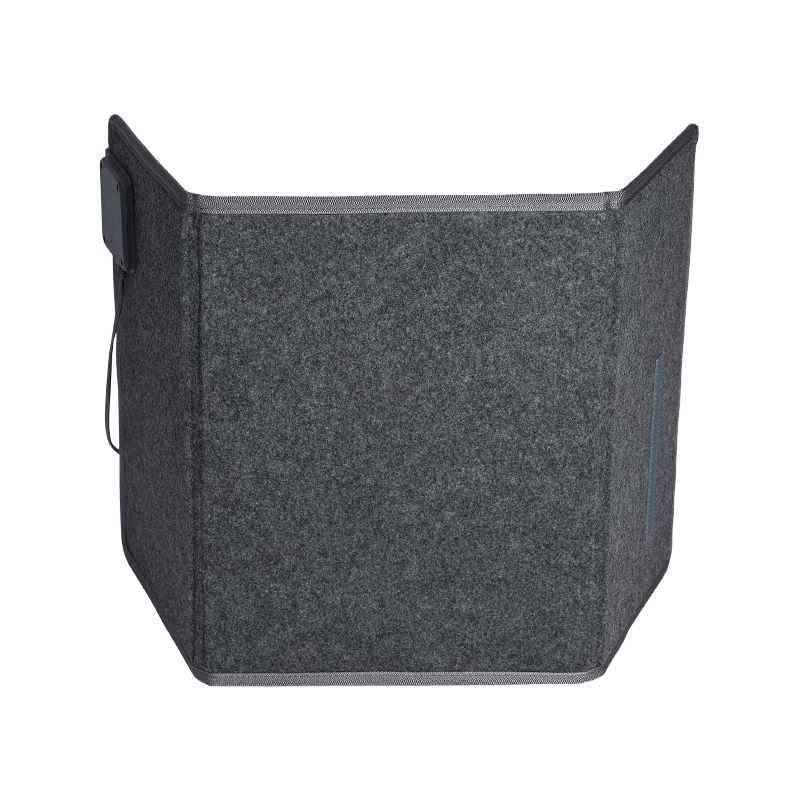
Three-Sided 3D Heater
Safety is a central requirement for any electrical heating appliance. The MT-PH-001 incorporates several protective functions intended to support stable daily use. These include automatic power-off when the unit is tilted, overheat protection, overvoltage protection, and a constant temperature control system.
The automatic power-off function is designed to respond when the heater is tilted to approximately 45 degrees. This feature helps reduce the risk associated with accidental movement, unstable placement, or tipping. If the unit is no longer positioned correctly, the protective mechanism can interrupt operation rather than allowing the heater to continue running in an unsuitable position.
Overheat protection helps monitor operating conditions and reduce the chance of excessive temperature buildup. Heating appliances must manage heat carefully, particularly when used in compact spaces. This protective function works together with the product’s structure and control system to support more stable operation.
Overvoltage protection is intended to help protect the appliance from electrical conditions that exceed its design requirements. Because electrical standards and supply conditions differ between countries and regions, buyers should confirm that the product voltage matches the intended market before ordering or using the heater.
The constant temperature control system helps maintain a more consistent heating experience. Rather than allowing the temperature to rise without regulation, the control system is designed to manage the selected heating level. Stable operation can improve comfort and reduce the need for frequent manual adjustment.
Protective features are not a substitute for careful use. The heater should not be covered with clothing, paper, bedding, or other materials that may restrict heat dissipation. It should be kept away from water, flammable objects, and unstable surfaces. Users should inspect the power cord and housing regularly and discontinue use if damage is observed.
Noise can have a significant effect on the usefulness of a heating appliance. In an office, fan noise may interfere with telephone calls or online meetings. In a bedroom, it may disturb sleep. In a study area, continuous motor noise can reduce concentration.
The Three-Sided 3D Heater operates without a fan, which supports a quiet personal heating experience. Its silent heating format is appropriate for home offices, bedrooms, reading areas, libraries, study spaces, and other environments where users prefer minimal background noise.
Quiet operation also makes the heater easier to integrate into a daily routine. A user can leave it operating during desk work without needing to tolerate the sound of air movement. The absence of a fan may also help reduce the circulation of dust that can occur with some fan-based heating products, although regular cleaning and appropriate indoor air management are still recommended.
The product provides selectable timer settings of 2, 4, and 6 hours. Timer operation is useful for users who want warmth during a defined period without relying on memory to switch the appliance off manually.
A two-hour setting may suit a short work session, an evening reading period, or a limited time in a cold room. A four-hour setting can support a longer office or study session. The six-hour option may be suitable for extended personal use when the user expects to remain in the same area for much of the day.
Timer control can contribute to more responsible energy use because it establishes a planned operating period. It is not necessary to run the heater throughout the entire day if warmth is only required at certain times. Users can select the shortest practical timer period and adjust the temperature downward after the personal space becomes comfortable.
Actual energy consumption depends on the selected temperature, duty cycle, operating time, local electricity rates, and electrical supply. At its rated 150W power, the heater is intended for personal heating rather than full-room heating. Buyers should evaluate the product according to their application and confirm technical details for their specific market.
With dimensions of approximately 50 × 37 × 32 centimeters, the heater is sized for personal spaces rather than large open rooms. Its shape can fit beneath many desks and around the lower leg area while leaving space for ordinary movement.
The product is suitable for home offices, corporate workstations, reception counters, study desks, bedrooms, living rooms, and other areas where focused warmth is required. Its compact format allows it to be moved between rooms as needed instead of remaining permanently installed in one location.
The foldable and space-saving design provides an additional practical advantage. During warmer seasons, the heater can be folded or stored in a cabinet, closet, utility room, or other storage area. Compact storage reduces clutter and makes the product easier to distribute in commercial environments such as offices, hotels, student residences, and serviced apartments.
Placement should be selected carefully. The product should stand on a stable, level surface with sufficient clearance around the heating panels. Users should avoid placing it where it may be struck by chairs, pulled by a cable, exposed to spilled liquids, or blocked by bags and other objects.
The listed material for the product is non-woven fabric. This material can support a lightweight and comfortable product structure while allowing manufacturers to create a soft, practical exterior for a personal heating enclosure. The final combination of fabric, heating components, supporting brackets, control elements, and protective parts must be assembled carefully to ensure reliable performance.
The anti-tip bracket structure helps stabilize the heater during operation. Stability is especially important for an under-desk product because users may move their legs, adjust their chair, or accidentally contact the unit. A well-supported structure helps maintain the intended position and works together with tilt protection.
For buyers evaluating private-label or customized versions, material selection can be adapted according to project requirements. Possible considerations include surface feel, color, thickness, cleanability, branding, structural stiffness, and packaging needs. Any material change should be evaluated for heat resistance, electrical safety, durability, and compliance with the regulations of the target market.
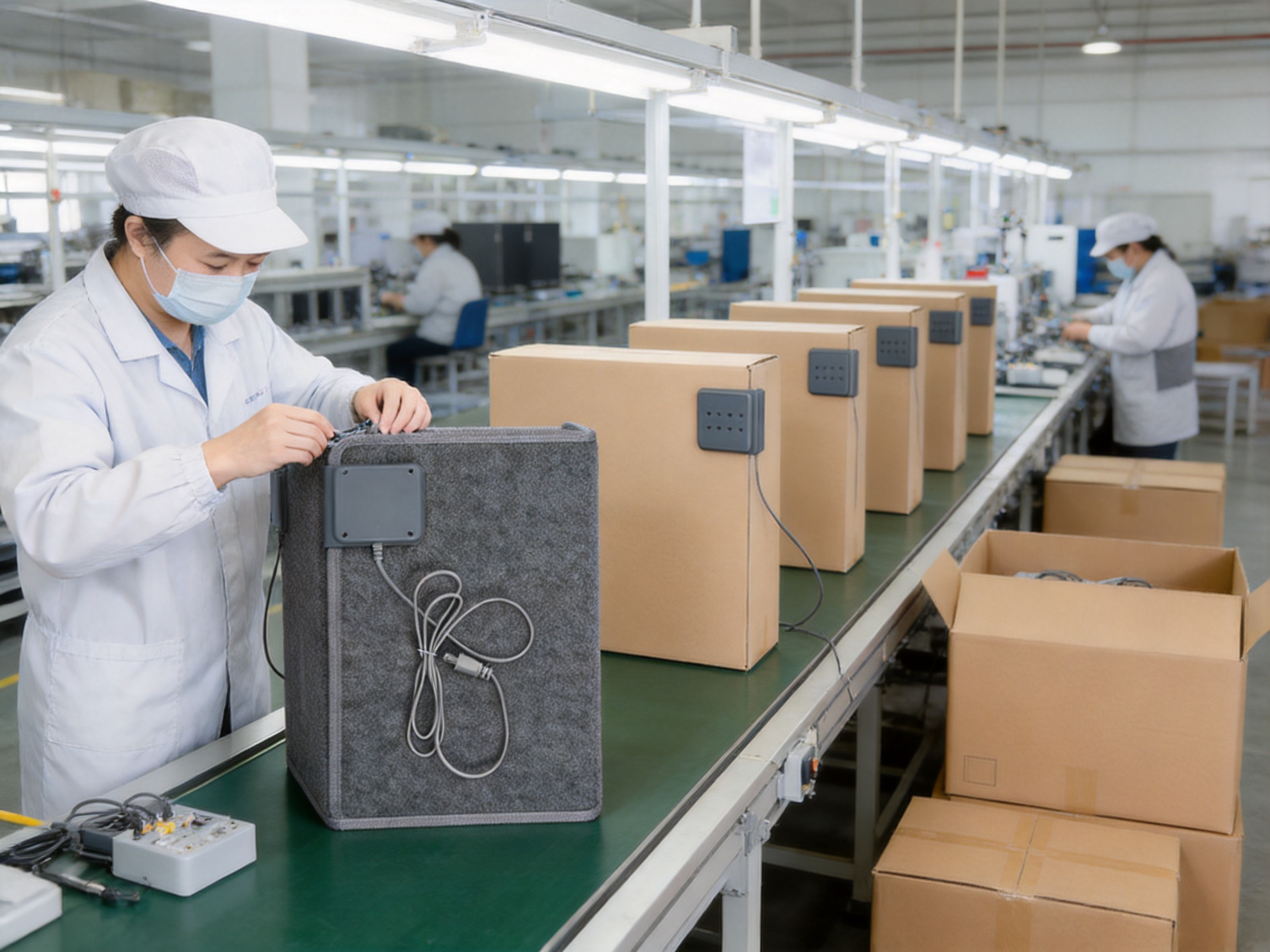
The manufacturer behind the product operates as an integrated home appliance producer with approximately 5,000 square meters of production facilities. Its capabilities include injection molding, sewing, assembly, and complete appliance manufacturing. This combination is valuable for a product such as the Three-Sided 3D Heater because the appliance includes both textile-related and electrical-mechanical components.
Injection molding capability supports the production of plastic housings, brackets, supports, control components, cable guides, and other formed parts. In-house or closely managed molding processes can help improve dimensional consistency and make it easier to adjust component designs during product development.
Sewing capability is relevant to the non-woven fabric structure and other textile-related elements. Controlled sewing operations can help maintain consistent panel dimensions, seam quality, surface appearance, and structural alignment. For a three-sided product, accurate textile assembly is particularly important because the panels must fit together correctly around the user’s personal heating area.
Assembly capability brings the product’s heating film, control system, protective devices, wiring, fabric components, brackets, and packaging into one finished unit. Effective assembly management helps ensure that electrical and structural components are installed according to the intended design rather than being treated as unrelated parts.
Complete appliance manufacturing also supports communication between product development and production teams. When design, component preparation, sewing, assembly, and final inspection are coordinated, potential issues can be identified earlier. This can reduce unnecessary revisions, improve production efficiency, and support more consistent delivery for wholesale customers.
An integrated manufacturing structure can provide stronger process visibility. Product specifications can be reviewed alongside production methods, material availability, assembly requirements, packaging details, and quality expectations. This is especially important for OEM and ODM projects, where a buyer may request changes to size, control layout, surface materials, colors, or branding.
Process control begins with the review of technical requirements. Engineers and production personnel can evaluate whether a requested feature is compatible with the heating system, structural design, electrical configuration, and intended use. The design can then be translated into components, production instructions, inspection points, and packaging specifications.
Quality management should continue throughout production rather than being limited to a final visual check. Relevant inspection stages may include incoming material evaluation, component measurement, fabric and sewing inspection, electrical connection review, heating performance testing, safety function verification, appearance inspection, and packaging confirmation.
For a heating appliance, production quality is closely connected to safety. Wiring, insulation, control components, protective systems, and heating surfaces must be assembled consistently. Stable production procedures help reduce variation between units and support dependable operation in the field.
The company maintains professional capabilities in research and development, product design, production management, and project support. These functions support the transition from an initial product concept to a manufacturable appliance.
Research and development can focus on heating performance, product structure, user comfort, protection functions, control methods, and material coordination. Design teams can address appearance, dimensions, usability, folding methods, panel arrangement, and packaging presentation. Production management can organize materials, scheduling, assembly, inspection, and delivery. Project support can coordinate customer communication and technical implementation.
This multidisciplinary approach is particularly useful when customers seek a differentiated product rather than a standard catalog item. The Three-Sided 3D Heater already offers a distinctive three-panel heating concept, but OEM and ODM buyers may want to adapt it for a particular market, retail channel, user group, or brand identity.
The product supports customization in several areas. Customers may discuss material and surface finishes, size and structural adjustments, control panel design, packaging, and branding. These options allow distributors, retailers, importers, and other buyers to develop a product that fits their commercial strategy.
Material customization can influence the appearance, tactile quality, durability, and perceived value of the heater. Buyers may request alternative colors, surface finishes, fabric textures, or other exterior treatments. Any proposed material should be assessed for suitability near heating elements and for compliance with relevant safety requirements.
Different markets may require different dimensions. An under-desk heater for a compact workstation may need a smaller footprint, while a product for a larger desk or shared workspace may require broader coverage. Structural adjustments can also involve folding methods, bracket design, panel angles, cable routing, and storage configuration.
The control panel can be adapted to meet user preferences or branding requirements. Possible areas for development include button layout, display style, indicator lights, control labeling, timer presentation, and temperature selection. A well-designed control panel should remain clear and easy to operate while preserving the core safety functions.
Packaging is important for both product protection and retail presentation. The standard packaging information lists one piece per color box, while larger wholesale programs may specify customized cartons, inserts, labels, manuals, barcodes, and shipping marks. Branding can be applied to the product, packaging, control panel, documentation, or promotional materials subject to project agreement.
The stated minimum order quantity is 1,500 pieces per color. This scale is suitable for importers, distributors, established retailers, and businesses planning a coordinated market launch. Buyers should confirm current MOQ, lead time, sample policy, certification requirements, packaging specifications, and final production terms before placing an order.
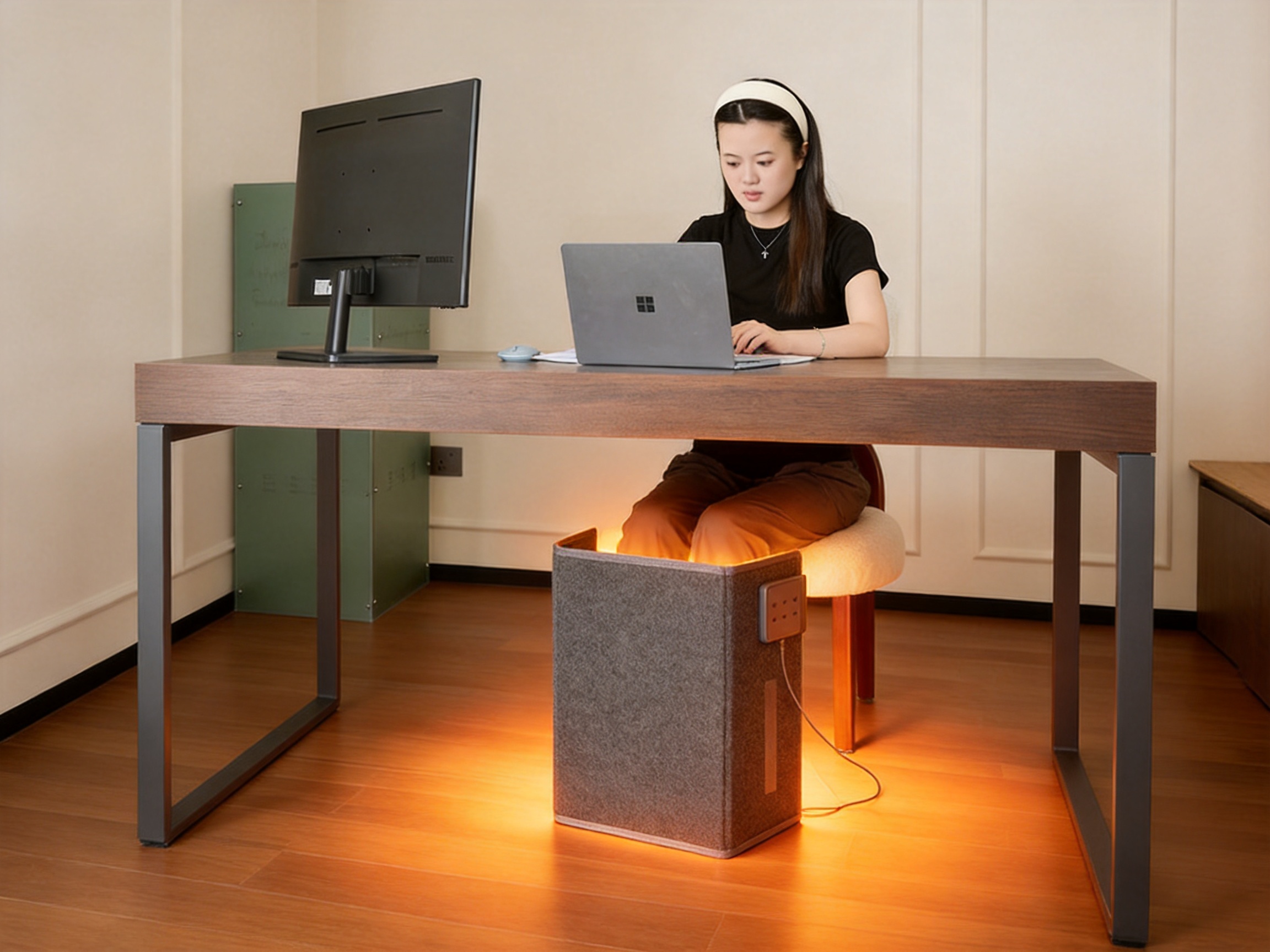
Home offices are one of the most suitable applications for the product. A person may spend several hours sitting at a desk while central heating maintains only a moderate room temperature. The heater can provide localized warmth around the legs and feet without requiring the entire home to be heated more intensely.
Office temperatures are not equally comfortable for all employees. A personal heater can provide individual comfort in workstations where building-wide temperature adjustments are impractical. Its quiet operation makes it appropriate for shared offices, provided that workplace electrical and safety policies permit personal heating appliances.
The fan-free design makes the heater suitable for bedrooms and reading corners where noise can be disruptive. It can provide personal warmth during reading, relaxing, or preparing for sleep. Users should always follow the timer and safety instructions and should not cover the unit with bedding or other materials.
Students often work for long periods at desks in rooms that may feel cold during winter. The compact footprint and low-power personal heating format can support a comfortable study area without occupying significant floor space.
Employees stationed at reception counters, security desks, ticket booths, and service points may remain seated in one location for extended periods. The three-sided structure can provide focused warmth in these work areas, especially when the surrounding building is large or difficult to heat uniformly.
Before using the heater, users should place it on a stable and level surface. The three-sided structure should remain open and unobstructed. The power supply should match the rated voltage, listed as 100V for the standard model. Buyers in other markets should discuss voltage versions and applicable electrical requirements with the supplier before ordering.
The heater should be positioned away from water sources, curtains, paper, clothing, bedding, aerosols, and other materials that may be affected by heat. The power cord should not pass through a walkway or be placed where it can be pulled or crushed.
Users should begin with the low or medium temperature setting and increase the level only when necessary. The timer should be selected according to the expected period of use. If the unit becomes damaged, emits an unusual odor, shows signs of overheating, or operates irregularly, it should be switched off and disconnected from the power source.
Cleaning should be performed only after the heater has been switched off, unplugged, and allowed to cool. The exterior can generally be kept free of dust using a soft, dry method suitable for the material. Liquids should not be poured onto the product, and abrasive cleaners should be avoided unless specifically approved by the instructions.
Regular inspection is especially useful in commercial environments. Staff can check the condition of the fabric, brackets, cable, plug, controls, and housing. A simple maintenance routine can help identify wear before it develops into a more serious problem.
Wholesale buyers should evaluate the product from both technical and commercial perspectives. Technical review may include rated voltage, power, temperature settings, timer operation, safety functions, dimensions, materials, plug configuration, manuals, and market compliance. Commercial review may include MOQ, color options, packaging, sample availability, production capacity, lead time, shipping arrangements, and after-sales support.
Because the product is intended for electrical heating, certification and testing requirements should be clarified early. Regulations vary by country and sales channel. Importers should identify the applicable standards for electrical appliances, heating products, electromagnetic compatibility, materials, labeling, packaging, and consumer safety in the target market.
Samples can be useful for evaluating heating coverage, perceived warmth, stability, fabric quality, control usability, noise level, packaging protection, and compatibility with local power supplies. For customized products, approval samples should be compared with production units to ensure that agreed specifications are maintained.
Product documentation should clearly explain operating procedures, temperature levels, timer settings, tilt protection, cleaning, storage, warnings, and electrical requirements. Clear instructions help reduce misuse and support a better customer experience after purchase.
The Three-Sided 3D Heater occupies a practical position between direct-contact warming products and larger room heaters. It provides more surrounding coverage than a simple flat panel while using a more focused format than many room-heating appliances. This balance can appeal to consumers who want personal comfort, quiet performance, compact storage, and controlled operation.
Its most visible point of differentiation is the three-sided heating structure. Many competing personal heaters are designed as flat surfaces or small directional units. A three-dimensional arrangement provides a clear design story for retailers and distributors: the heater is intended to create a warmer personal zone around the user rather than merely projecting heat forward.
The product also combines several features in one compact appliance. Rapid heating, three temperature levels, timer selection, fan-free operation, folding storage, and safety protection create a complete user proposition. Buyers do not need to choose between speed, silence, adjustability, and compactness as separate product categories.
For business customers, the availability of OEM and ODM support adds another advantage. A product can be adapted for different retail identities, market expectations, colors, sizes, and packaging systems. This flexibility can help customers build a differentiated product line rather than competing only on price.
The manufacturer was established in 2023 and specializes in home appliance product development and production. Its product focus includes heating appliances, cooling appliances, furniture-related household electrical products, and other practical home and office solutions.
The approximately 5,000-square-meter production operation provides a foundation for coordinated manufacturing. Injection molding, sewing, assembly, and complete appliance production are all relevant to the development of compact household electrical products. This combination can support better alignment between product design and production execution.
The company emphasizes practicality, safety, comfort, and market adaptability. These priorities are reflected in the product’s personal heating concept, quiet operation, adjustable control, protective functions, and customization support. The focus is not limited to producing a heating component; it includes designing a usable appliance for real home and office conditions.
Its participation in professional exhibitions, including the Tokyo Gift Show, provides opportunities to observe market trends, understand customer preferences, and communicate with buyers from different regions. International market exposure can help a manufacturer recognize differences in packaging, design, functionality, and product positioning.
For overseas customers, communication and project coordination are important parts of supplier performance. A professional team covering research and development, design, production management, and project support can help clarify requirements and reduce misunderstandings during customized development.
The product can be positioned as a personal winter comfort appliance, an under-desk heating solution, a quiet office heater, a compact bedroom warmer, or an energy-conscious supplement to central heating. The strongest positioning should emphasize the three-sided structure and personal heat coverage rather than presenting it as a replacement for a high-output room heater.
Retail descriptions can focus on the user experience: warmth around the legs, fast heating, quiet operation, simple controls, flexible timer settings, and compact storage. Business buyers may additionally highlight OEM and ODM capability, color customization, packaging development, and factory-direct project support.
For online and offline sales, demonstrations can be especially effective. Showing the three-panel shape, folding method, control options, and placement beneath a desk can help customers understand how the product differs from a conventional flat heater. Clear safety communication should accompany all demonstrations.
The MT-PH-001 is a three-sided 3D panel heater designed primarily for personal and under-desk heating. It is intended to create a focused warming zone around the user rather than heat a large room.
The product uses heating panels on three sides. This arrangement is intended to improve coverage and help reduce cold areas compared with a single flat, front-facing heating surface.
The product is designed to reach a useful heating level in approximately 15 seconds when operated under appropriate conditions. Actual perceived warmth may vary depending on room temperature, placement, clothing, and ventilation.
There are three listed temperature levels: low at approximately 40°C, medium at approximately 50°C, and high at approximately 60°C.
No. The product uses a fan-free heating design, so it is intended to operate quietly. This makes it suitable for offices, bedrooms, study rooms, and other quiet environments.
The selectable timer settings are 2, 4, and 6 hours. Users can choose the operating period that best matches their activity and comfort requirements.
The listed protections include automatic power-off when tilted to approximately 45 degrees, overheat protection, overvoltage protection, and constant temperature control. Users should still follow all instructions and operate the heater on a stable, unobstructed surface.
The listed power rating is 150W. This rating reflects the product’s personal heating purpose rather than whole-room heating performance.
The listed voltage is 100V. Buyers should confirm voltage, plug configuration, and local compliance requirements before purchasing for a particular country or region.
The listed size is approximately 50 × 37 × 32 centimeters. The compact design is intended to fit beneath desks and in other personal-use spaces.
The listed material is non-woven fabric. Customers seeking alternative materials or surface finishes can discuss customization options with the manufacturer, subject to technical and safety evaluation.
Yes. Available customization areas include materials and surface finishes, dimensions, structural details, control panel design, packaging, branding, and other OEM or ODM requirements.
The listed MOQ is 1,500 pieces per color. Buyers should confirm current production terms and requirements during project discussions.
Typical applications include under desks, home offices, corporate offices, bedrooms, living rooms, study spaces, reception counters, and other areas requiring focused personal warmth.
No. It is designed as a personal heating solution and can complement existing room or building heating. Its purpose is to warm a smaller area around the user rather than provide full-room heating for a large space.
After switching off, unplugging, and allowing the unit to cool completely, users can store it in a clean and dry location. Its foldable, space-saving design supports seasonal storage where appropriate.
The Three-Sided 3D Heater offers a focused and practical approach to personal warmth. Its three-panel structure distinguishes it from conventional flat heaters by creating broader coverage around the user. Rapid heating, three temperature levels, timer control, fan-free operation, compact dimensions, folding storage, and multiple protection systems combine to support everyday use in homes, offices, bedrooms, and study areas.
Its 150W design is suited to targeted heating rather than large-room heating, making it an attractive option for users who need additional comfort at a desk or in a personal seating area. The product’s greatest advantage is the way its structure, controls, quiet performance, and safety functions work together as one focused heating solution.
For importers, distributors, and private-label buyers, the product is supported by a manufacturing operation with injection molding, sewing, assembly, and complete appliance production capabilities. These resources create a foundation for product customization, controlled development, coordinated production, and OEM or ODM cooperation.
With suitable market-specific electrical compliance, clear instructions, responsible operation, and appropriate positioning, the Three-Sided 3D Heater can serve as a differentiated addition to the personal heating category. It combines practical comfort with a distinctive structure and provides a flexible platform for customers seeking a modern, quiet, compact, and customizable household heating product.
1. Product specification sheet for MT-PH-001 Three-Sided 3D Heater, including dimensions, material, voltage, power, timer settings, temperature levels, and safety functions.
2. Manufacturer-provided product description and application information for three-sided personal and under-desk heating appliances.
3. Manufacturer-provided company profile covering appliance development, injection molding, sewing, assembly, production management, and OEM/ODM support.
4. General principles of electrical appliance safety, including stable placement, overheat protection, voltage compatibility, and safe operating clearances.
5. General product development and quality management practices for compact household electrical appliances.
Falling asleep quickly and staying asleep through the night depend on more than just a dark, quiet room. Body temperature plays a central, often underappreciated role in the sleep...
READ MORECleaning has traditionally been one of the most time consuming and physically demanding tasks in both household and commercial settings. Whether it involves scrubbing floors, vacu...
READ MOREIn office environments where air conditioning runs year-round, or during winter months with inadequate central heating, workers seated for extended periods regularly experience ...
READ MOREUnderstanding Portable Cooling Fans and Their Applications Across Different Environments Portable cooling fans represent efficient, lightweight personal cooling solutions providin...
READ MOREThe heated eye mask is good for your eyes in most cases — particularly for people suffering from dry eye disease, meibomian gland dysfunction (MGD), eye fatigue, or poor sleep. Wh...
READ MOREAs households increasingly seek ways to stay comfortable while managing energy costs, the Energy-Efficient Smart Heated Throw Blanket has emerged as a practical solution that blen...
READ MORE