English
 日本語
 한국어
 Deutsch
Home > Author > Tang Ruihe — Regional Product Sales Manager > Rechargeable Electric Cleaning Brushes: A Practical Guide to Faster, Easier Deep Cleaning
Content
Household cleaning is often less difficult because of the dirt itself than because of the repeated physical effort required to remove it. Soap scum, grease, dried spills, grime in tile joints, and residue around sinks can demand prolonged scrubbing with considerable pressure. Manual cleaning can also place stress on the hands, wrists, elbows, and shoulders, particularly when the same household tasks must be performed frequently.
The MT-CB-001 Rechargeable Electric Cleaning Brush is designed to reduce that effort through powered, cordless scrubbing. Combining a compact ergonomic body, a high-torque motor, replaceable brush heads, a rechargeable battery, and waterproof construction, it is intended for kitchens, bathrooms, footwear, upholstery, vehicles, and a variety of outdoor cleaning tasks. Instead of relying entirely on arm strength, users can guide the brush across a surface while its motor provides the repetitive scrubbing motion.
This product is also positioned as a practical option for wholesalers, retailers, distributors, hospitality businesses, cleaning-equipment suppliers, and brands seeking an adaptable household appliance. Its specifications support everyday consumer use, while its manufacturing background provides opportunities for OEM and ODM development. The combination of useful performance, manageable size, Type-C charging, and customization potential gives the product several advantages in a competitive cleaning-tool market.
Traditional cleaning brushes remain inexpensive and useful, but they transfer nearly all of the work to the user. Removing a stubborn mark often requires repeated back-and-forth movement, firm downward pressure, and awkward hand positions. The problem becomes more noticeable when cleaning large areas such as bathroom floors, shower walls, kitchen surfaces, patio furniture, or vehicle wheels.
An electric cleaning brush changes the working method. The user still controls the direction, contact angle, and amount of pressure, but the motor performs much of the repetitive movement. This can help shorten cleaning sessions and make difficult tasks more manageable. It is particularly useful when the same area requires multiple passes or when grime has accumulated over time.
The value of a powered brush is not simply its motor speed. A successful product must also be comfortable to hold, sufficiently durable, easy to recharge, safe around moisture, and simple to maintain. If a cleaning tool is powerful but uncomfortable, it may be abandoned after occasional use. If it is convenient but lacks adequate torque, it may not provide a meaningful advantage over a manual brush. The MT-CB-001 addresses these considerations as a complete product system rather than as a motor attached to a handle.
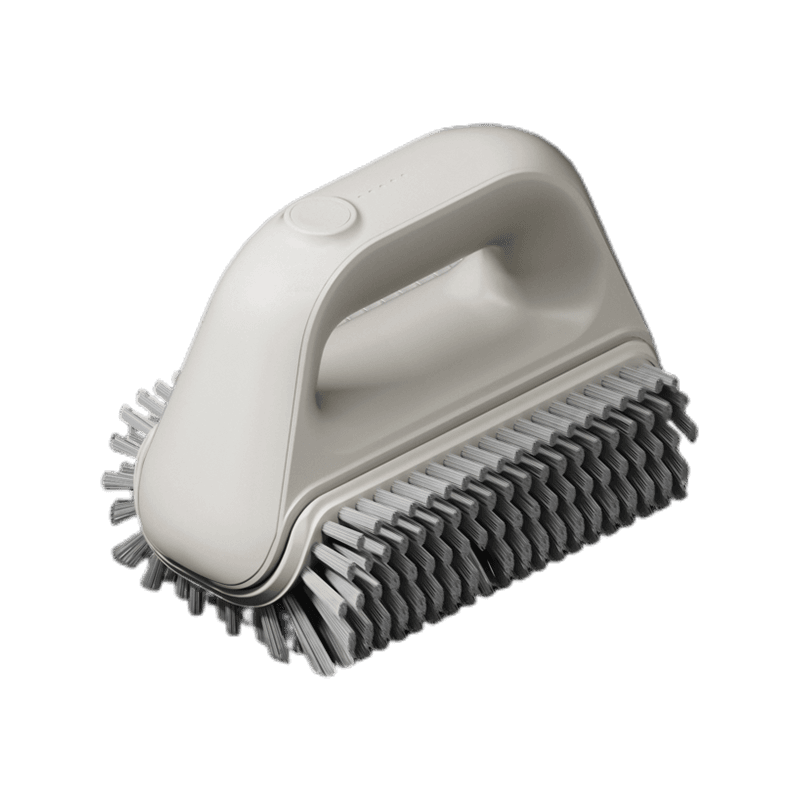
The MT-CB-001 is a rechargeable electric cleaning brush developed for household and light commercial applications. It has a compact listed size of 14 × 5 × 8 centimeters, making it suitable for storage in a cabinet, utility drawer, bathroom shelf, or cleaning-supply area. Its cordless design avoids the restrictions associated with power cords and allows users to move between rooms or work outdoors without remaining close to a wall outlet.
The main body uses ABS plastic, while the brush components use PP and PET materials. This combination is widely used in household appliances and cleaning tools because it balances lightweight handling, structural strength, processability, and resistance to regular contact with water and cleaning solutions. The body is intended to withstand normal daily handling, while the bristles are designed to lift dirt without unnecessarily scratching suitable surfaces.
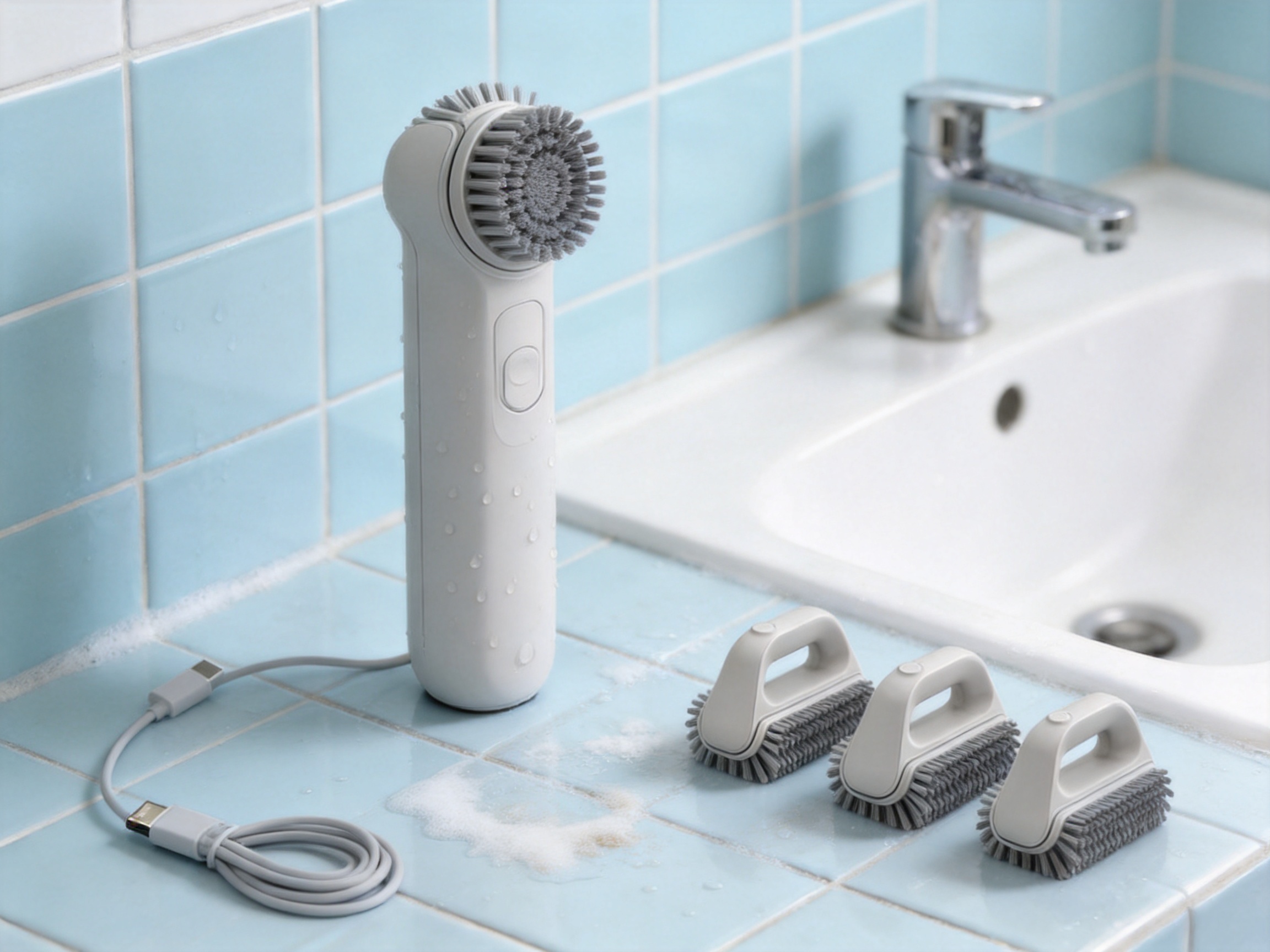
The product is powered by a 3.7-volt, 2600mAh rechargeable battery and uses a Type-C input for charging. The listed working time is approximately 60 to 90 minutes, with a charging time of about four hours. Actual runtime may vary depending on speed selection, brush-head resistance, surface contact, battery condition, and operating temperature. Even with these variables, the stated capacity is suitable for multiple short cleaning sessions or one extended household cleaning session.
The motor is rated at 10 watts and can reach up to 1200 revolutions per minute. This speed is intended to provide fast, consistent scrubbing for common household contaminants such as soap residue, grease, dirt, and dried deposits. The brush also includes adjustable operating speeds. The supplied product information refers to both two-level and three-setting speed control; final retail specifications should therefore be confirmed for the intended production version and market packaging. In either case, adjustable speed allows the user to match the tool to the surface and cleaning task.
Specification | Listed Detail |
Model | MT-CB-001 |
Product Type | Rechargeable electric cleaning brush |
Product Size | 14 × 5 × 8 cm |
Motor Power | 10W |
Voltage | 3.7V |
Charging Interface | Type-C input |
Battery Capacity | 2600mAh |
Working Time | Approximately 60–90 minutes |
Charging Time | Approximately 4 hours |
Maximum Speed | Up to 1200 RPM |
Main Materials | ABS body with PP and PET brush components |
Water Resistance | IPX7 listed |
Packaging | One piece per color box |
Warranty | One year |
Minimum Order Quantity | 1,500 pieces per color |
Smart Electric Cleaning Brushes
The most direct advantage of an electric cleaning brush is the ability to maintain consistent movement. Manual scrubbing speed changes as the user becomes tired, adjusts grip, or encounters a particularly resistant patch of dirt. A motorized tool can maintain a repeatable rotation while the user moves the brush across the surface.
With a maximum speed of up to 1200 RPM and a 10W motor, the MT-CB-001 is designed to deliver more active scrubbing than a conventional handheld brush. The motor does not eliminate the need for suitable cleaning technique, but it can reduce the amount of physical repetition required. For dried soap deposits, kitchen grease, and dirt lodged in textured surfaces, consistent rotation can help loosen contamination before it is wiped or rinsed away.
Speed should always be used appropriately. A higher setting may be useful for robust surfaces, heavy grime, or outdoor equipment. A lower setting is more suitable for delicate materials, painted surfaces, coated fixtures, fabrics, and areas where excessive friction could cause damage. Users should test an inconspicuous area first and select cleaning agents and brush heads according to the surface manufacturer’s instructions.
The performance advantage over a standard brush is therefore based on controlled mechanical assistance rather than on speed alone. The operator can focus on positioning the tool and managing water or cleaning solution instead of repeatedly generating the brushing motion by hand.
Different cleaning jobs require different levels of force. A bathroom grout line may require concentrated scrubbing, while a smooth sink basin may need only light agitation. Upholstery and footwear may also require a gentler approach than a patio tile or vehicle wheel.
Adjustable speed gives the product greater versatility than a single-speed cleaning appliance. The user can begin at a lower setting to assess how a surface responds, then increase the power if additional agitation is needed. This approach may help reduce splashing, limit unnecessary wear, and improve control around corners, edges, and fixtures.
The product materials describe the brush as offering three distinct speed settings in the feature explanation while also referring to two-level control in the specification section. For commercial listings, buyers and distributors should confirm the final control configuration before printing packaging or preparing advertising. Regardless of whether the production version uses two or three levels, the principle remains valuable: speed selection allows the same compact tool to serve both gentle and heavy-duty cleaning tasks.
Cordless operation is one of the most practical improvements over a conventional corded cleaning device. A user can carry the brush from a bathroom to a kitchen, utility room, balcony, garage, or outdoor area without searching for an outlet. The absence of a trailing cable also reduces the chance of tangling around furniture, fixtures, or the user’s feet.
The 2600mAh battery is designed to provide approximately 60 to 90 minutes of operation. This range is sufficient for many household tasks because cleaning is usually performed in intervals rather than continuously for an entire day. A user may clean a sink, shower area, or kitchen worktop in a few minutes and then return the brush to its storage location.
Type-C charging adds convenience because the connector is widely used across current personal electronics and household accessories. Consumers may already have compatible charging equipment at home, while retailers can present Type-C connectivity as a familiar and modern feature. The charging port also supports a product design that is easier to integrate into compact housings than older connector formats.
A four-hour charging period means the brush should be recharged after use when possible, particularly if it is needed for a larger cleaning project. Battery performance depends on operating speed, load, temperature, charging habits, and storage conditions. For product documentation, clear instructions should explain that the device should be charged with a compatible power source, kept dry around the charging port, and stored according to the manufacturer’s recommendations.
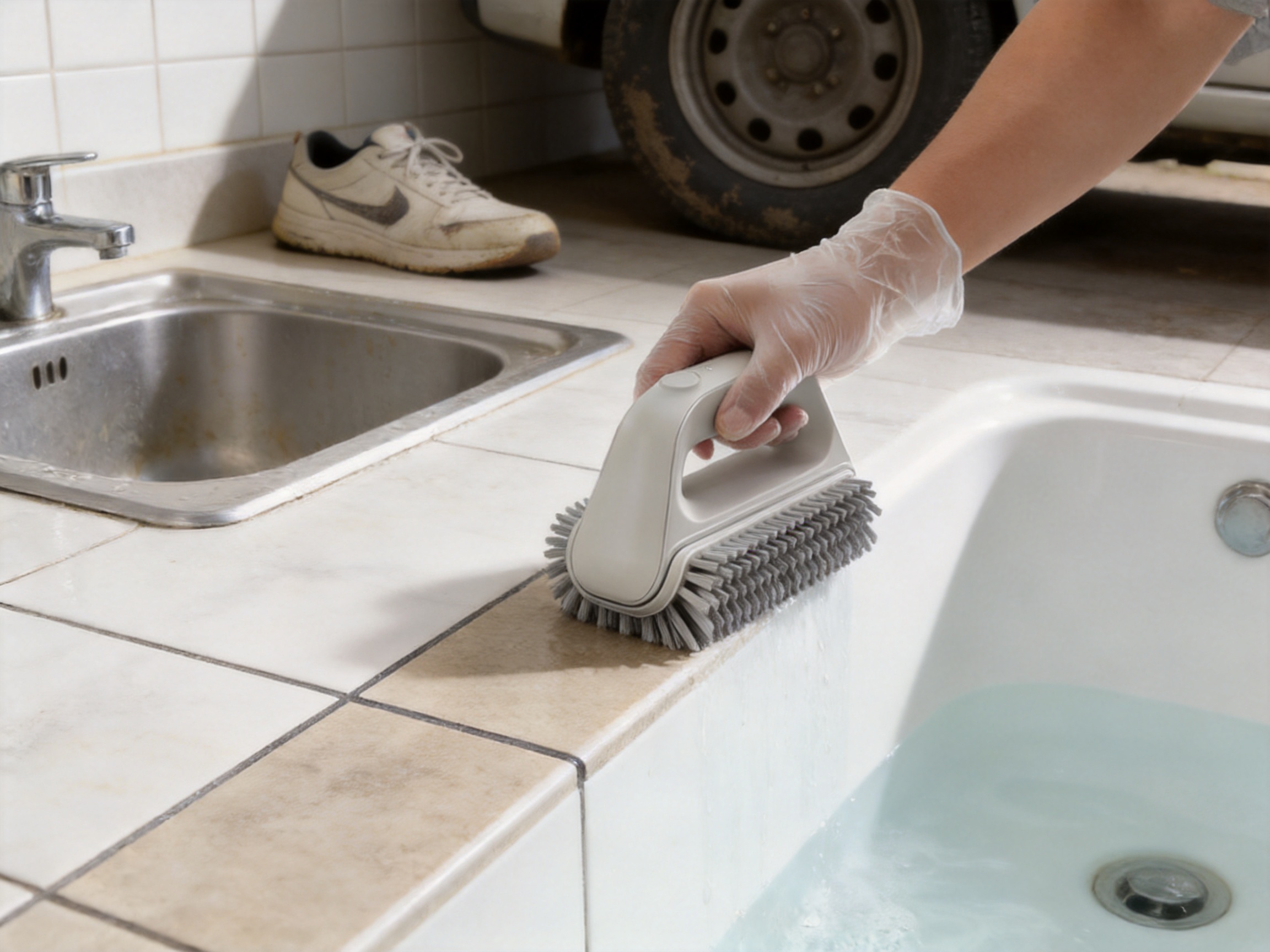
Bathroom and kitchen cleaning frequently involve splashes, running water, damp surfaces, and occasional immersion. A product designed for these rooms must take moisture exposure into account. The MT-CB-001 is listed with an IPX7 waterproof rating, indicating a high level of protection against water ingress under defined test conditions.
This rating is particularly relevant for cleaning sinks, bathtubs, showers, tile walls, and other wet areas. It gives users greater confidence that normal water exposure will not immediately damage the internal electronics. It can also make rinsing the brush head more convenient after use, helping remove loose residue before the tool is stored.
Water resistance does not mean that every use condition is automatically safe. The charging port should be closed or protected as instructed, and the product should not be charged while wet. Users should also avoid corrosive chemicals, excessive heat, unauthorized disassembly, and conditions outside the product’s operating instructions. Retailers should communicate the IPX7 rating accurately rather than presenting it as unlimited protection against every liquid or cleaning chemical.
Compared with non-water-resistant electric tools, a waterproof design is a clear advantage in the household cleaning category. It allows the tool to be used where cleaning is most demanding and reduces the inconvenience of moving between dry and wet operating methods.
Cleaning tools are often used in awkward positions. The user may need to reach into a sink, stretch across a bathtub, work along a wall, or hold a brush at an angle against a vertical surface. A bulky or poorly balanced product can quickly become uncomfortable even when its motor is powerful.
The MT-CB-001 uses a compact body intended to fit comfortably in the hand. Its ergonomic form helps the user direct the brush without relying on an excessively tight grip. Because the motor supplies the repetitive scrubbing action, the user does not need to make the same rapid wrist movements required by a manual brush.
Reduced hand and wrist movement can be beneficial for people who clean frequently, manage multiple household tasks, or experience discomfort during extended manual scrubbing. The product does not remove all physical effort: users still need to hold, guide, refill, rinse, and reposition the tool. However, it can shift the task from forceful repetitive brushing to controlled movement and surface management.
Ergonomics also contributes to safety. A stable grip can help reduce accidental slips, especially when the product is used around water. The exact comfort experience depends on hand size, brush-head design, surface angle, and cleaning pressure, so distributors should encourage customers to use an appropriate grip and avoid forcing the brush into a surface.
A cleaning brush is only as useful as its contact surface. Different tasks can benefit from different shapes, bristle densities, stiffness levels, or profiles. A narrow head may reach corners and grout lines, while a broader head may cover more area on a bathtub, floor, or countertop.
The MT-CB-001 uses a detachable brush-head structure. This provides two important benefits. First, the head can be removed for cleaning after use. Rinsing and drying the bristles helps reduce the buildup of dirt, soap, and cleaning-product residue. Second, the head can be replaced when the bristles become worn, allowing the main motor body to remain in service for a longer period.
Replaceability gives the product an advantage over low-cost disposable cleaning tools or sealed products with no serviceable contact components. It may also support additional sales opportunities for replacement heads and specialized attachments. For retailers, the availability of accessory heads can increase product usefulness while creating a more complete category offering.
The manufacturer also supports a variety of specialized brush-head attachments through its OEM and ODM program. Depending on the target market, a brand may request a configuration for bathroom cleaning, footwear care, kitchen maintenance, vehicle detailing, or general household use. Any attachment should be evaluated for compatibility, balance, bristle durability, and surface safety before commercialization.
The main body is made from ABS, a material commonly selected for appliance housings because it offers a useful balance of impact resistance, dimensional stability, appearance, and molding efficiency. A well-designed ABS housing can protect internal components while remaining light enough for handheld operation.
PP and PET are used in the brush components. Polypropylene is valued for its chemical resistance and flexibility, while PET can provide suitable stiffness and resilience for bristles and related components. The combination enables manufacturers to adjust the feel of the brush according to its intended application.
Material selection is closely connected to manufacturing quality. A reliable product requires more than a material name on a specification sheet. The plastic grade, molding temperature, component thickness, rib structure, fastening method, and quality-control standards all affect the final result. Bristle attachment, shaft alignment, housing fit, sealing elements, and switch performance must also be monitored during assembly.
For buyers comparing electric cleaning brushes, material transparency is a useful advantage. Clear information about ABS, PP, and PET helps importers assess product positioning, packaging claims, and potential compliance requirements. It also provides a foundation for developing different versions, such as a standard household model, a premium finish, or a specialized attachment kit.
Bathrooms contain many surfaces where powered scrubbing can be useful. The brush can be applied to bathtubs, tile surfaces, sink basins, shower areas, and selected grout lines. Soap scum and mineral residue can be difficult to remove when they have dried, especially on textured surfaces. The rotating brush can help loosen these deposits after the appropriate cleaning solution has been applied.
Users should choose a suitable speed and attachment for glazed tile, acrylic, glass, enamel, and other bathroom materials. Excessive pressure should be avoided on delicate finishes. The brush should also be rinsed and dried after use so that residue does not remain in the bristles.
Kitchen surfaces frequently accumulate oil, food residue, and dried spills. The MT-CB-001 can assist with sinks, stovetops, counters, splash areas, and other compatible surfaces. Its cordless construction is convenient because the user can move around appliances and worktops without managing a cable.
Cleaning agents should be selected according to the material being cleaned. Stainless steel, coated surfaces, stone, ceramic, and plastic may respond differently to abrasive action. The brush is best used as a controlled agitation tool rather than as a substitute for correct chemical selection or safe food-contact practices.
A powered brush can also assist with cleaning sneakers, shoe soles, fabric sections, and selected upholstery. The user should select a soft or appropriate attachment and test a concealed area before cleaning visible sections. Excessive moisture should be avoided on materials that are sensitive to water, dye transfer, or saturation.
The advantage in this category is precision. A compact brush can focus on stained sections rather than requiring the entire item to be soaked or manually scrubbed. For footwear retailers, laundry businesses, and home-care product suppliers, a compatible brush attachment could broaden the product’s appeal beyond routine surface cleaning.
Outdoor furniture, sporting equipment, patio surfaces, bicycle components, and vehicle wheels may collect dirt that is difficult to remove with a cloth alone. A powered brush provides additional agitation for these applications, particularly when the surface has grooves, tread patterns, or textured finishes.
Outdoor use should be carried out within the device’s operating limits. Abrasive particles should be rinsed from the brush after use, and the product should be stored in a clean, dry location after the battery and charging area have been protected. The tool should not be used on surfaces where rotating bristles could damage coatings, seals, electrical components, or sensitive finishes.
Application | Typical Cleaning Target | Recommended Operating Approach |
Bathroom | Bathtubs, sinks, tile, shower areas, grout | Use suitable moisture protection, moderate pressure, and an appropriate head |
Kitchen | Stovetops, counters, sinks, splash areas | Apply a compatible degreaser and avoid scratching sensitive finishes |
Footwear | Soles, sneakers, selected fabric surfaces | Test a hidden area and use a softer attachment when necessary |
Upholstery | Spot areas and durable fabrics | Control moisture and use gentle pressure |
Outdoor Items | Patio furniture, sporting goods, vehicle wheels | Remove abrasive particles and rinse the brush after use |
The product competes with several categories, including manual brushes, corded electric scrubbers, low-capacity rechargeable tools, and non-replaceable compact cleaners. Its competitive position comes from the balance of features rather than from one isolated specification.
Compared with a manual brush, the MT-CB-001 provides powered rotation, which can reduce repetitive hand movement. Compared with a corded electric scrubber, it offers greater mobility and does not require the user to work near an outlet. Compared with basic rechargeable brushes, its 2600mAh battery and listed 60-to-90-minute operating range support longer sessions. Compared with sealed low-cost products, its detachable brush head improves maintenance and supports replacement.
The IPX7 rating is another important differentiator for wet-room applications. Many household tasks involve water, and a product that is designed specifically for damp environments can be easier to integrate into daily routines. Type-C charging adds another practical advantage by using a current connector standard familiar to consumers.
Its compact dimensions also support convenient storage and packaging. A retailer can position the product as a household maintenance tool rather than a large specialty appliance. It may appeal to apartment residents, families, older consumers seeking to reduce manual effort, busy professionals, short-term rental operators, and cleaning-service providers handling small-scale tasks.
Competitive claims should remain accurate and supported by testing. Speed, runtime, waterproofing, noise, torque, and brush durability should be verified for each production configuration. A responsible product presentation is more valuable over time than an exaggerated claim that may lead to customer dissatisfaction or compliance concerns.
Ningbo Meeting Industrial & Trading Co., Ltd. was established in 2023 as an integrated manufacturer specializing in household appliance development and production. The company operates approximately 5,000 square meters of production facilities and supports several stages of the manufacturing process, including injection molding, sewing, assembly, and complete appliance production.
This integrated structure is significant for a product such as an electric cleaning brush. The housing must be formed accurately, the battery and motor must be installed securely, the waterproof structure must be assembled consistently, and the brush head must align correctly with the drive mechanism. When these activities are coordinated within one manufacturing system, the company can maintain closer communication between design, production, and quality-control teams.
Injection molding is central to the production of the ABS and PP components used in the cleaning brush. A well-managed molding process helps maintain dimensional consistency, surface appearance, wall thickness, fastening points, and compatibility between housing sections. Proper mold design also supports efficient production at larger quantities, which is important for the listed minimum order quantity of 1,500 pieces per color.
For a handheld waterproof appliance, molding precision is especially important. Housing parts must fit together correctly, and sealing areas must be formed with appropriate consistency. The company’s in-house or closely coordinated injection-molding capability can make it easier to adjust colors, surface finishes, structural details, and future housing revisions.
Complete appliance assembly requires coordination among the motor, battery, control system, charging interface, housing, brush shaft, switch, and sealing elements. Assembly workers and quality personnel must ensure that components are correctly positioned and that the finished unit operates as intended.
A structured assembly process can include incoming component inspection, semi-finished product checks, functional testing, appearance inspection, charging verification, speed testing, and final packaging inspection. The precise inspection plan depends on the production configuration and applicable market requirements, but the general objective is consistent performance from unit to unit.
The company maintains professional teams covering research and development, design, production management, and project support. This is useful for brands that require more than a standard catalog product. Product development may involve changes to the housing shape, color, brush-head system, battery capacity, packaging, branding, or control interface.
Design support is particularly valuable in the household appliance market because usability and appearance influence purchasing decisions. A brush must look approachable, feel balanced, fit the intended retail environment, and communicate its purpose clearly through packaging. The manufacturer’s integrated teams can help convert a general product concept into a production-ready design.
OEM and ODM projects can encounter delays when design, tooling, sourcing, production, and packaging are managed by disconnected suppliers. An integrated manufacturing partner can simplify communication by coordinating these activities through a more unified project structure.
Ningbo Meeting emphasizes clear communication and efficient collaboration across design concepts, production details, and delivery schedules. For international buyers, this can help reduce misunderstandings concerning artwork, color references, component specifications, sampling, inspection standards, and shipping preparation.
As with any supplier relationship, buyers should confirm documentation, testing procedures, sample approval processes, production timelines, and quality expectations before placing a commercial order. A strong process is most effective when both parties define measurable requirements at the beginning of the project.
The MT-CB-001 can serve as a foundation for private-label and customized cleaning-tool programs. The available customization directions include housing colors, material finishes, brush-head attachments, battery capacity, logos, and color-box packaging.
Color customization allows retailers and brands to align the product with an existing visual identity. Neutral colors may be suitable for general household channels, while bright colors can improve visibility on retail shelves. Matte, glossy, or textured finishes may create different impressions of grip, durability, and product quality.
Color development should be controlled through approved samples and standardized references. The appearance of molded plastic can vary depending on resin batch, surface texture, lighting, and production conditions. A documented approval process helps reduce disputes between sample and mass production.
Different markets may prioritize different cleaning tasks. A bathroom-oriented package could include a medium-bristle head and a narrow head for corners. A footwear package might use a softer brush, while an outdoor-care package may require a more durable, higher-resistance attachment.
Brush-head customization should consider motor load. A larger or stiffer head may place greater demand on the motor and battery, potentially affecting runtime and heat generation. Any customized attachment should therefore be tested with the intended body, speed settings, and operating conditions.
The standard 2600mAh battery provides a useful balance between operating time, size, weight, and charging requirements. Some markets may request a higher-capacity battery for extended commercial use, while others may prioritize a lighter product for occasional household cleaning.
Battery upgrades must be evaluated as complete electrical and mechanical changes. They may affect internal space, charging time, product weight, thermal behavior, transport classification, and regulatory documentation. The manufacturer’s development team can help determine whether a requested capacity is practical for the chosen housing.
Branded logos can be applied through suitable production methods selected according to the housing material and surface finish. Packaging can also be customized with product photography, operating instructions, safety information, barcode labels, warranty details, and market-specific language.
The standard packaging is listed as one piece per color box. Buyers may request changes to the box design, insert structure, carton quantity, protective materials, and shipping marks. Good packaging should protect the brush during transportation while clearly explaining its main benefits and correct use.
Household electrical products must be marketed with clear and responsible information. The product should be accompanied by instructions covering charging, water exposure, cleaning, storage, brush-head replacement, surface compatibility, and safe operation. Users should be told not to charge the device while wet and should be advised to use only compatible charging equipment.
Quality assurance should address both visible and internal features. Appearance checks can identify scratches, molding defects, color inconsistencies, loose components, or poor packaging. Functional checks can confirm motor operation, speed control, charging response, battery behavior, switch performance, and brush-head engagement.
Waterproof performance should be verified through an appropriate testing program rather than assumed from housing appearance. Similarly, runtime should be measured using defined conditions, since actual performance changes with speed, contact pressure, attachment type, and battery condition. Buyers may request inspection records or agree on pre-shipment testing criteria as part of the purchasing process.
The listed one-year warranty provides a basis for after-sales support. Warranty terms should specify coverage, exclusions, replacement procedures, and handling of consumable brush heads. Clear warranty communication can improve customer confidence and help distributors manage service expectations.
A practical cleaning routine begins with selecting the correct attachment and checking that the brush head is firmly installed. The user should remove loose debris from the surface where appropriate, apply a compatible cleaning product, and allow it to work according to its instructions. The brush can then be started at a lower speed before increasing power if necessary.
Users should guide the tool rather than force it into the surface. Excessive pressure may slow the motor, increase battery consumption, accelerate bristle wear, or damage a sensitive material. Short, overlapping passes are often more effective than holding the brush in one place for too long.
After cleaning, the brush head should be detached and rinsed when appropriate. Dirt and cleaning residue should be removed from the bristles and connection area. The device should be wiped according to the instructions, allowed to dry, and stored away from excessive heat. The charging port should remain protected and completely dry before charging.
This workflow helps preserve performance and extends the usable life of both the tool and its attachments. It also makes the product easier to explain in retail packaging, user manuals, demonstration videos, and customer-service materials.
The household cleaning category benefits from products that demonstrate an obvious practical improvement. A powered brush can be shown in use, compared with manual scrubbing, and explained through familiar cleaning scenarios. Its compact size makes it suitable for online product pages, home-goods stores, appliance retailers, hardware channels, and promotional gift catalogs.
The product also has multiple selling points that can be adapted to different market segments. For general consumers, the central message may be reduced cleaning effort. For apartment residents, cordless convenience and compact storage may be more important. For older users, ergonomic assistance can be emphasized. For cleaning-service providers, runtime, replaceable heads, and waterproof construction may be more relevant.
OEM buyers can develop separate packages for different channels using the same basic platform. One version might include a standard brush head for kitchen and bathroom use, while another includes additional attachments for footwear or vehicle care. Such variations can help brands test market demand without designing an entirely new appliance for every application.
The minimum order quantity of 1,500 pieces per color is suited to planned wholesale programs rather than very small trial orders. Buyers should consider forecasted demand, color selection, packaging requirements, accessory quantities, and replacement-head planning before confirming production. Early sample evaluation can help determine whether changes are needed before the full order enters production.
Product performance is influenced by the entire manufacturing chain. A good concept can lose value through inconsistent molding, poor sealing, weak assembly control, unsuitable packaging, or slow communication. An integrated supplier with capabilities in product development, injection molding, assembly, and project management can provide a more coordinated route from specification to finished goods.
Ningbo Meeting’s focus on heating appliances, cooling appliances, furniture-related household electrical products, and practical home-use devices gives it experience within the broader household-appliance field. Although the MT-CB-001 belongs to the cleaning category, it reflects the same development priorities: safe operation, stable performance, comfort, practical design, and suitability for daily life.
The company’s participation in professional exhibitions, including the Tokyo Gift Show, also supports awareness of market trends and customer expectations. International exposure can help a manufacturer understand differences in retail presentation, product functions, packaging preferences, and regional purchasing behavior.
For a buyer, the key benefit is not merely access to a product specification. It is the ability to work with a supplier that can discuss the complete project: intended users, target price, product configuration, testing requirements, packaging, branding, production schedule, and after-sales support.
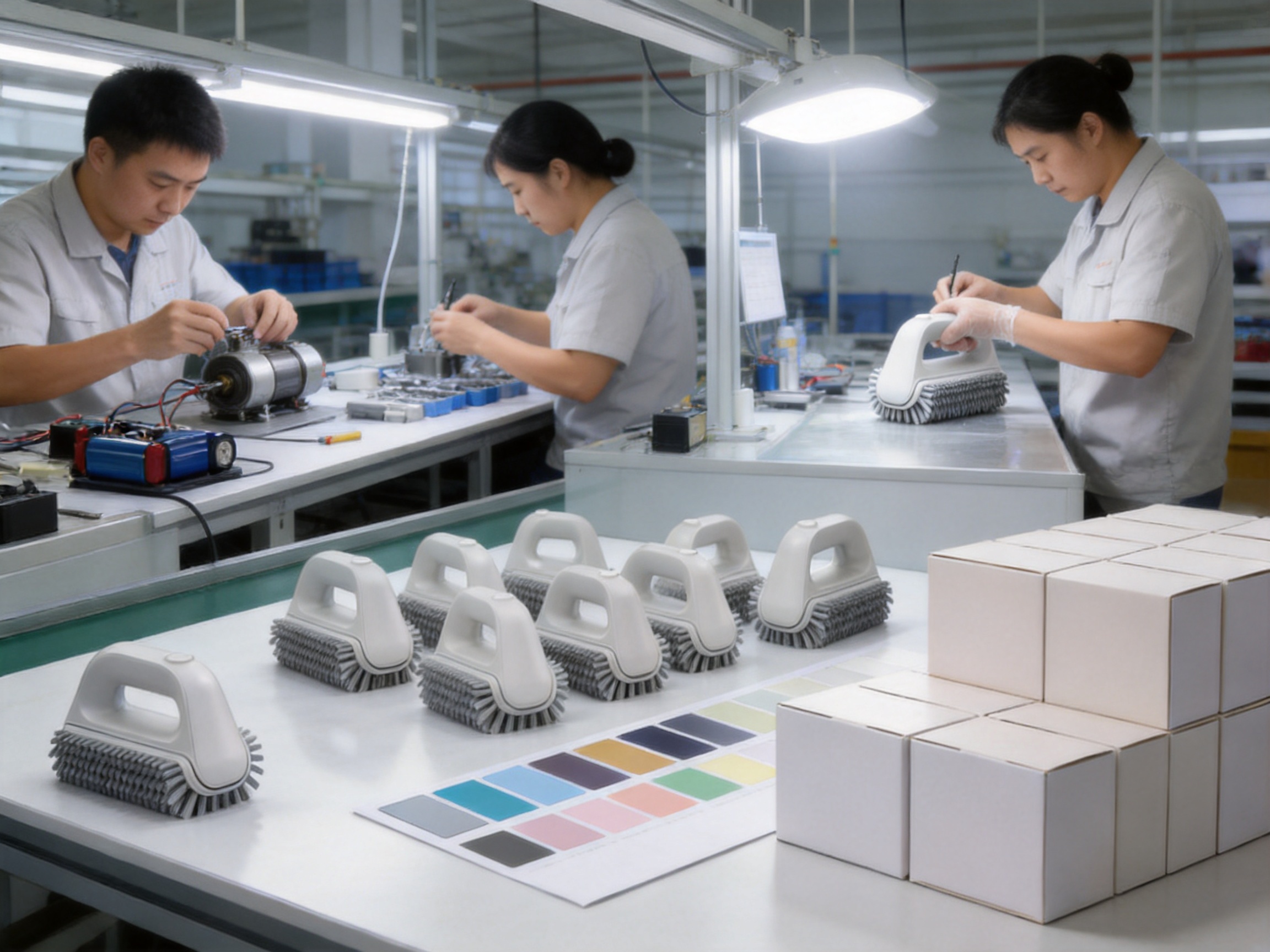
The brush is designed for a broad range of household and light utility applications, including bathtubs, sinks, tile, shower areas, kitchen surfaces, stovetops, footwear, selected upholstery, patio furniture, vehicle wheels, and sporting equipment. The correct brush head, speed, cleaning solution, and pressure should be selected for each surface.
The listed motor power is 10 watts, and the maximum operating speed is up to 1200 RPM. Performance will vary according to the brush attachment, surface resistance, battery charge, and amount of pressure applied by the user.
The listed working time is approximately 60 to 90 minutes. The actual duration depends on speed selection, brush-head resistance, surface contact, battery condition, and operating conditions.
The listed charging time is approximately four hours. The brush uses a Type-C input. Users should follow the supplied charging instructions and ensure that the charging port and device are dry before charging.
The product is listed with an IPX7 waterproof rating and is intended for wet-environment applications. However, it should not be charged while wet, and users should follow all instructions concerning the charging port, cleaning chemicals, immersion, and storage.
Yes. The brush head is designed to be detachable and replaceable. This allows users to clean the attachment after use and replace worn bristles. Specialized brush-head configurations may also be available through OEM or ODM development.
Yes. The product information describes adjustable speed control. One section refers to two levels, while another describes three distinct speed settings. The final control configuration should be confirmed with the manufacturer for the selected production version and market packaging.
The main housing uses ABS, while the brush components use PP and PET. These materials are selected for a balance of lightweight handling, durability, processability, and suitability for household cleaning applications.
Customization options include housing colors, material finishes, specialized brush heads, battery-capacity upgrades, branded logos, and custom color-box packaging. The feasibility of each change should be reviewed because modifications can affect tooling, weight, runtime, testing, packaging, and production cost.
The listed minimum order quantity is 1,500 pieces per color. Buyers should confirm the final quantity, sample policy, accessory requirements, packaging specifications, and delivery schedule before placing an order.
The listed warranty is one year. The specific coverage, exclusions, service process, and treatment of consumable brush heads should be confirmed in the commercial agreement and product documentation.
The product is manufactured by Ningbo Meeting Industrial & Trading Co., Ltd., a Ningbo-based household-appliance manufacturer with capabilities covering research and development, design, injection molding, assembly, and project support.
The MT-CB-001 Rechargeable Electric Cleaning Brush is built around a straightforward consumer need: making demanding cleaning tasks easier, faster, and less physically tiring. Its 10W motor, speed adjustment, cordless operation, 2600mAh battery, Type-C charging, compact form, detachable brush head, and listed IPX7 waterproof rating create a practical combination for bathrooms, kitchens, footwear, upholstery, vehicles, and outdoor items.
Its advantages over conventional manual brushes include powered scrubbing, more consistent movement, reduced wrist effort, and broader day-to-day usability. Compared with basic electric alternatives, it adds useful features such as longer listed runtime, replaceable brush components, modern charging, and wet-environment suitability. These benefits make it appropriate for both direct consumer sales and private-label product programs.
The manufacturing foundation is equally important. Ningbo Meeting Industrial & Trading Co., Ltd. provides integrated capabilities in product development, injection molding, assembly, and complete household-appliance production. Its professional teams support design communication, production management, customization, and project implementation. For buyers seeking a cleaning appliance that can be adapted to different markets, the company’s OEM and ODM services provide a route toward customized colors, attachments, batteries, branding, and packaging.
As with any electrical cleaning tool, final performance depends on correct use, appropriate surface selection, battery care, quality control, and accurate product documentation. When these factors are managed carefully, the MT-CB-001 can serve as a reliable and commercially adaptable addition to the modern household cleaning category.
1. Product specification and feature information for the MT-CB-001 Rechargeable Electric Cleaning Brush, supplied in the product materials.
2. Company profile and manufacturing capability information for Ningbo Meeting Industrial & Trading Co., Ltd., supplied in the company materials.
3. General principles of injection molding, thermoplastic material selection, and appliance assembly quality control.
4. General guidance on rechargeable lithium-battery product handling, charging safety, and consumer appliance documentation.
5. General principles of ingress-protection classification and responsible communication of water-resistance ratings.
Cleaning has traditionally been one of the most time consuming and physically demanding tasks in both household and commercial settings. Whether it involves scrubbing floors, vacu...
READ MOREAn Electric Cleaning Brush Replaces Hand Pressure With Motor-Driven Scrubbing Power An electric cleaning brush uses a small motor to spin or vibrate a brush head at speeds ranging...
READ MOREFalling asleep quickly and staying asleep through the night depend on more than just a dark, quiet room. Body temperature plays a central, often underappreciated role in the sleep...
READ MOREYou unbox your new electric blanket, spread it on the bed, and then stop. Which side goes up? It is one of the most common questions for first-time users, and for good reason. The...
READ MOREYou settle onto the couch on a cold winter evening, blanket spread across your lap, and hesitate before reaching for the plug. How much electricity will this actually use? Most he...
READ MOREWhen your eyes feel itchy, gritty or puffy, reaching for something cool is a natural reaction, and it is usually a sensible one. A cold compress is one of the simplest home measur...
READ MORE