English
 日本語
 한국어
 Deutsch
Home > Author > Luo Yanjun — Senior After-Sales Service Manager > Compact Waterproof Heated Floor Mat for Safe, Efficient Everyday Warmth
Content
Personal comfort often depends on warmth in specific areas rather than heating an entire room. A cold floor beneath a desk, a chilly bedside area, or an uncomfortable reading corner can make ordinary activities less pleasant, especially during colder seasons. Traditional room heating can require substantial energy, while portable heaters may occupy valuable space, create airflow, or warm areas that do not need additional heat. A compact heated floor mat offers a more targeted alternative by delivering warmth directly beneath the feet and lower body.
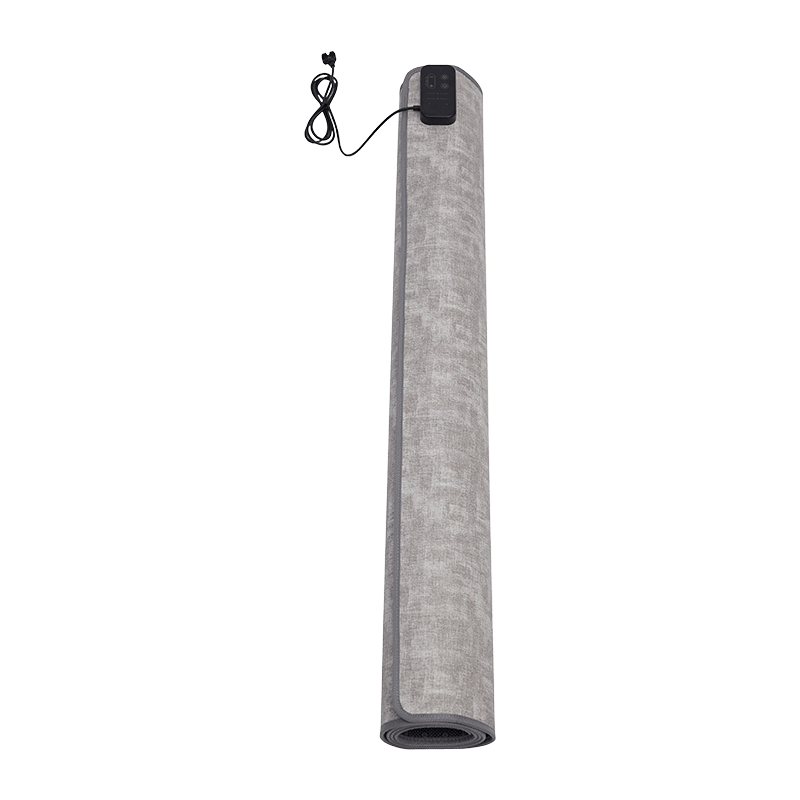
The Safety Waterproof Heating Mat, model MT-DN-002, is designed for this purpose. Measuring 150 × 100 cm, it provides a practical heating area for personal use while remaining compact enough for offices, bedrooms, apartments, and other limited spaces. Its PVC and fabric construction combines a durable outer surface with a comfortable feel, while its 560W heating system is intended to provide stable and efficient warmth.
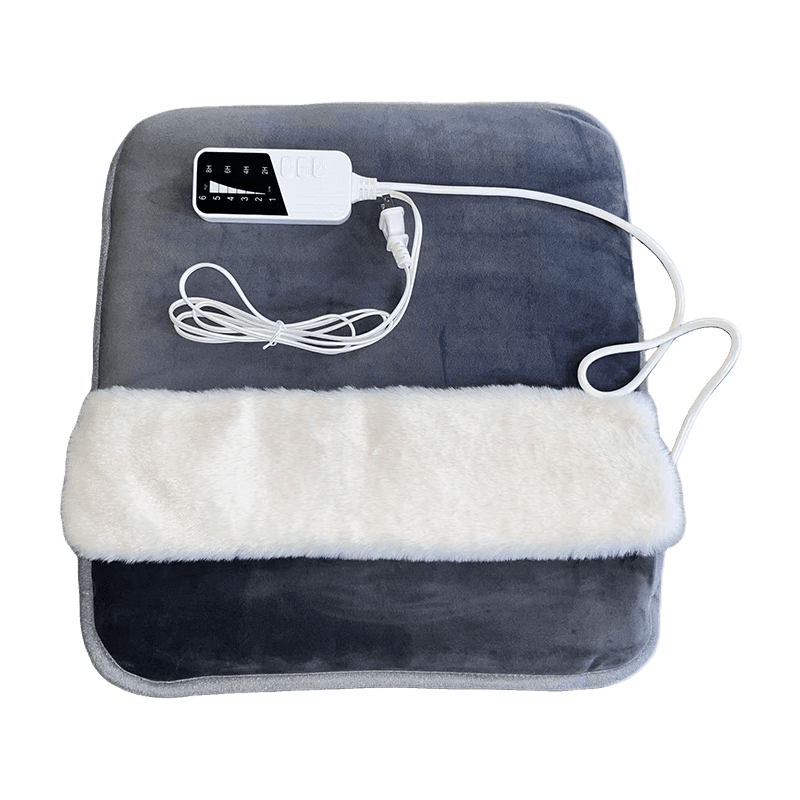
The mat includes four temperature levels, a timer with four selectable settings, water-resistant protection rated to the IPX7 standard, a child safety lock, and a low electromagnetic field design. These features are intended to support convenient daily operation and help distinguish the product from simple heating pads that offer limited control or fewer protective functions.
Beyond the product itself, the manufacturing background is also important for wholesale buyers, distributors, retailers, and OEM customers. The manufacturer operates an integrated production facility with injection molding, sewing, assembly, and complete appliance manufacturing capabilities. This integrated structure supports better control of materials, components, production procedures, customization, and delivery coordination.
This article examines the product’s design, functional advantages, applications, safety features, manufacturing strengths, customization opportunities, and suitability for different markets.
The MT-DN-002 is a compact heated floor mat developed for targeted warmth in personal spaces. Its 150 × 100 cm format provides sufficient coverage for use beneath a desk, in front of a chair, beside a bed, or in a small relaxation area. Unlike a full-room heating appliance, the mat is intended to warm the immediate area where a person sits, works, reads, rests, or stands.
The product uses a 560W heating system and operates at 100V. Four temperature levels allow users to select a setting according to room conditions and personal preference. The temperature range extends from approximately 27°C to 55°C, with the control levels divided into low, medium, high, and high-plus ranges.
The timer function offers 3-hour, 6-hour, 9-hour, and 12-hour options. This gives users the flexibility to select a short operating period for work or relaxation, or a longer period for extended use. Automatic shut-off scheduling can also reduce the need to monitor the product continuously.
The mat is made from PVC and fabric options. PVC can provide a practical, durable, and easy-to-clean surface, while fabric options can add a softer touch and a warmer visual appearance. Depending on the selected configuration, the product can be positioned for home use, office use, pet comfort, or private-label retail programs.
| Specification | Details |
|---|---|
| Product model | MT-DN-002 |
| Product type | Compact heated floor mat |
| Dimensions | 150 × 100 cm |
| Rated power | 560W |
| Rated voltage | 100V |
| Material options | PVC and fabric |
| Temperature control | Four levels |
| Temperature range | Approximately 27°C–55°C |
| Timer settings | 3, 6, 9, and 12 hours |
| Water-resistance protection | IPX7 standard according to the supplied specification |
| Safety functions | Child safety lock and low EMF design |
| Packaging | One piece per color box |
| Warranty | One year |
| Minimum order quantity | 1,500 pieces per color |
One of the product’s main advantages is its targeted heating concept. Conventional room heaters are designed to increase the temperature of a larger air volume. This approach may be appropriate for some environments, but it can also mean that energy is used to heat unused areas. A heated floor mat concentrates warmth in the personal zone immediately around the user.
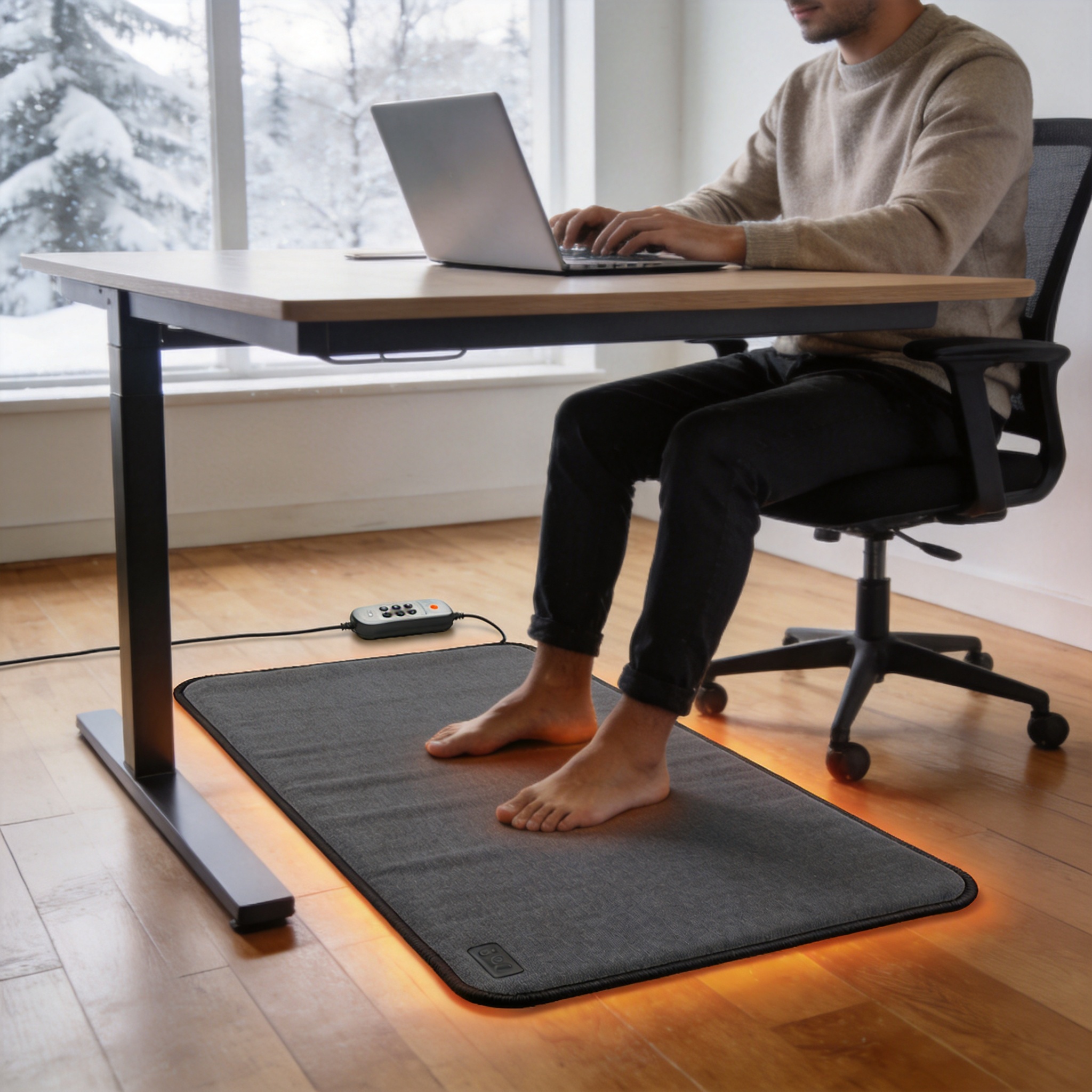
For someone working at a desk, the area beneath the desk is often colder than the upper part of the room. A person may feel cold at the feet and legs even when the room’s air temperature is acceptable. Placing the mat beneath the desk can create a more comfortable micro-environment without requiring a large heater beside the chair.
The same principle applies in bedrooms, reading areas, home offices, and small apartments. The user can position the mat where warmth is most valuable instead of heating the entire room. This can be especially useful in spaces where a full-size heating appliance would be inconvenient, visually intrusive, or difficult to store.
Compared with a small personal heating pad, the 150 × 100 cm surface provides broader coverage. It can accommodate both feet and part of the lower body, rather than warming only a narrow section. This wider format makes it practical for use under a desk or in front of a sofa, where the user may shift position during work or relaxation.
The design also supports different user habits. A person may place a chair on one side of the mat, extend the legs across its surface, or use it as a warm zone near a bed. This flexibility helps the product serve multiple everyday scenarios without requiring complicated installation.
The 560W heating system is designed to provide fast heat-up and stable operation within the mat’s intended personal heating area. The power level is selected to support meaningful warmth across a 150 × 100 cm surface while maintaining a compact appliance format.
Four temperature levels allow users to adjust the heating output according to the environment. The low setting covers approximately 27°C to 32°C and can be suitable when only mild warmth is needed. The medium setting covers approximately 32°C to 37°C and may be useful for routine desk work or reading. The high setting covers approximately 38°C to 44°C, while the high-plus setting reaches approximately 50°C to 55°C for situations requiring stronger warmth.
| Control level | Approximate temperature range | Potential use |
|---|---|---|
| Low | 27°C–32°C | Light warmth during mild weather or extended use |
| Medium | 32°C–37°C | Routine office work, reading, or relaxation |
| High | 38°C–44°C | Colder rooms and stronger personal heating |
| High-plus | 50°C–55°C | Rapid warming or colder conditions, subject to responsible use |
The multi-level system is more adaptable than a simple on-and-off heating design. Basic heating mats with one fixed output may provide too much warmth in some conditions and too little in others. Adjustable levels allow the user to respond to changing temperatures throughout the day.
Temperature control can also improve comfort during long working sessions. A user may begin with a higher setting to warm cold feet and later reduce the temperature once comfort has been restored. This reduces the need to switch the entire product off and on repeatedly.
For commercial buyers, adjustable heating can be an important selling point. Retail customers increasingly look for products that offer practical control rather than a single operating mode. Four clearly defined levels are easy to explain in product packaging, online listings, and user manuals.
Actual warming performance can vary according to room temperature, floor material, surface coverage, user position, and product configuration. The stated temperature ranges should therefore be understood as product specifications rather than a guarantee of identical surface conditions in every environment.
The integrated timer provides four operating periods: 3 hours, 6 hours, 9 hours, and 12 hours. These options are designed to accommodate short, medium, and extended periods of use.
A 3-hour setting can be useful for a focused work session, evening reading, or a short period of relaxation. The 6-hour setting may suit a longer workday or an extended period in a home office. The 9-hour option can accommodate a full daytime schedule, while the 12-hour setting offers longer coverage for users who spend much of the day in one location.
Automatic shut-off is valuable because it reduces reliance on memory. Users may become distracted while working, reading, watching television, or resting. A timer allows them to select an operating period in advance instead of leaving the mat running indefinitely.
The timer also supports energy-conscious use. A user can match the operating period to actual needs and avoid unnecessary heating after leaving the area. For retailers, the timer is an easy-to-understand benefit that adds practical value without significantly increasing the complexity of daily operation.
The timer should not be treated as a substitute for responsible use. Users should follow the instruction manual, inspect the product before operation, and switch off or disconnect the mat if unusual heat, damage, odor, or malfunction is observed.
The product specification identifies IPX7 water-resistant protection. This level of protection is intended to provide a higher degree of resistance against water exposure than ordinary dry-use heating mats. It can be especially relevant for floor-level products, where accidental spills, damp footwear, cleaning activities, or household moisture may be possible.
Water-resistant protection contributes to user confidence, but it does not eliminate the need for proper handling. The power controller, cable, plug, and connections must be used according to the product instructions. The mat should not be operated if its electrical components are damaged, and users should not deliberately immerse or misuse the product unless the complete product design and instructions specifically permit such treatment.
The PVC and fabric construction is intended to balance durability and comfort. PVC can provide a surface that is relatively simple to wipe and maintain, which is useful for a floor-level product. Fabric options can support a softer and more domestic appearance, helping the mat fit into bedrooms, living rooms, and offices.
Easy maintenance is an important advantage over products with delicate or difficult-to-clean surfaces. A floor mat may come into contact with dust, lint, pet hair, and occasional spills. A practical surface helps reduce the effort required to keep the product presentable and ready for use.
The material selection also supports different market positions. A PVC-focused version may be suitable for customers who prioritize durability and cleaning convenience. A fabric-focused version may appeal to consumers who value softness, home décor, and a warmer tactile experience. These options allow distributors to create product variations for different customer groups.
Safety is a central consideration for any electrical heating appliance. The MT-DN-002 includes several functions intended to improve operating safety and user convenience, including a child safety lock, timer control, water-resistant protection, and low EMF design.
The child safety lock is intended to help prevent accidental operation or unintended changes to the settings. This can be useful in households with children or pets, particularly when the mat is placed in a shared room or near a low table.
The lock is a supportive feature rather than a replacement for supervision. Children and pets should not be allowed to play with the controller, power cord, or mat. The product should be positioned so that cables do not create a tripping or pulling hazard.
The product is described as having a low electromagnetic field design. This reflects an effort to reduce electromagnetic exposure associated with normal operation. The feature can be meaningful for consumers who actively look for comfort products with additional electrical design considerations.
Claims concerning electromagnetic performance should always be assessed according to applicable testing procedures, market regulations, and product documentation. For distributors, maintaining clear technical records and using accurate labeling is important when presenting this feature to customers.
The timer contributes to safer operation by allowing the user to define an operating period. Automatic shut-off can be particularly useful when the product is used during periods of relaxation, since users may be less likely to remember to turn it off manually.
As with any heating product, the mat should be placed flat and used on an appropriate surface. It should not be folded, sharply creased, covered by unsuitable materials, or used with damaged cords and controllers. Users should consult the supplied instructions for all installation, cleaning, storage, and operating requirements.
The listed safety features provide a foundation for responsible operation, but final product compliance depends on the complete production configuration, electrical components, testing, labeling, and destination-market requirements. Importers and distributors should confirm the appropriate certifications and documentation before placing the product on a specific market.
The product’s competitive value can be understood by comparing it with several common alternatives: conventional room heaters, basic heating pads, oversized electric blankets, and low-feature floor mats.
A room heater is designed to warm the surrounding air, whereas the MT-DN-002 is designed to warm the user’s immediate floor area. This targeted approach can be more practical for people who occupy only one section of a room. The mat does not need to be placed on a table or positioned to blow air toward the user, and it can remain beneath a desk or chair.
The mat also avoids the moving airflow associated with fan-based heaters. Some users find direct airflow uncomfortable, especially during long periods of desk work. A floor mat provides conductive warmth through the surface rather than relying on air circulation.
Many basic heating pads have a smaller format and are intended for a specific body area. The 150 × 100 cm size provides broader floor coverage, making it more suitable for feet, legs, and personal seating zones. The four temperature levels and four timer selections also provide more control than a product with only one heat setting.
Heated blankets are primarily designed for use on beds or sofas. A floor mat has a different placement and purpose. It supports seated or standing activities at a desk, beside a bed, or in a reading area. Its floor-based format can be more suitable for office environments and locations where a blanket would be inconvenient.
Some basic electric floor mats offer limited controls and few protective functions. The MT-DN-002 combines adjustable temperature, timer scheduling, water-resistant protection, child lock functionality, and low EMF design in one product concept. This combination can make it easier for retailers to position the product as a more complete personal comfort solution.
No single heating product is ideal for every application. The strongest competitive advantage of this model is its combination of compact coverage, adjustable comfort, scheduled operation, practical materials, and safety-oriented functions.
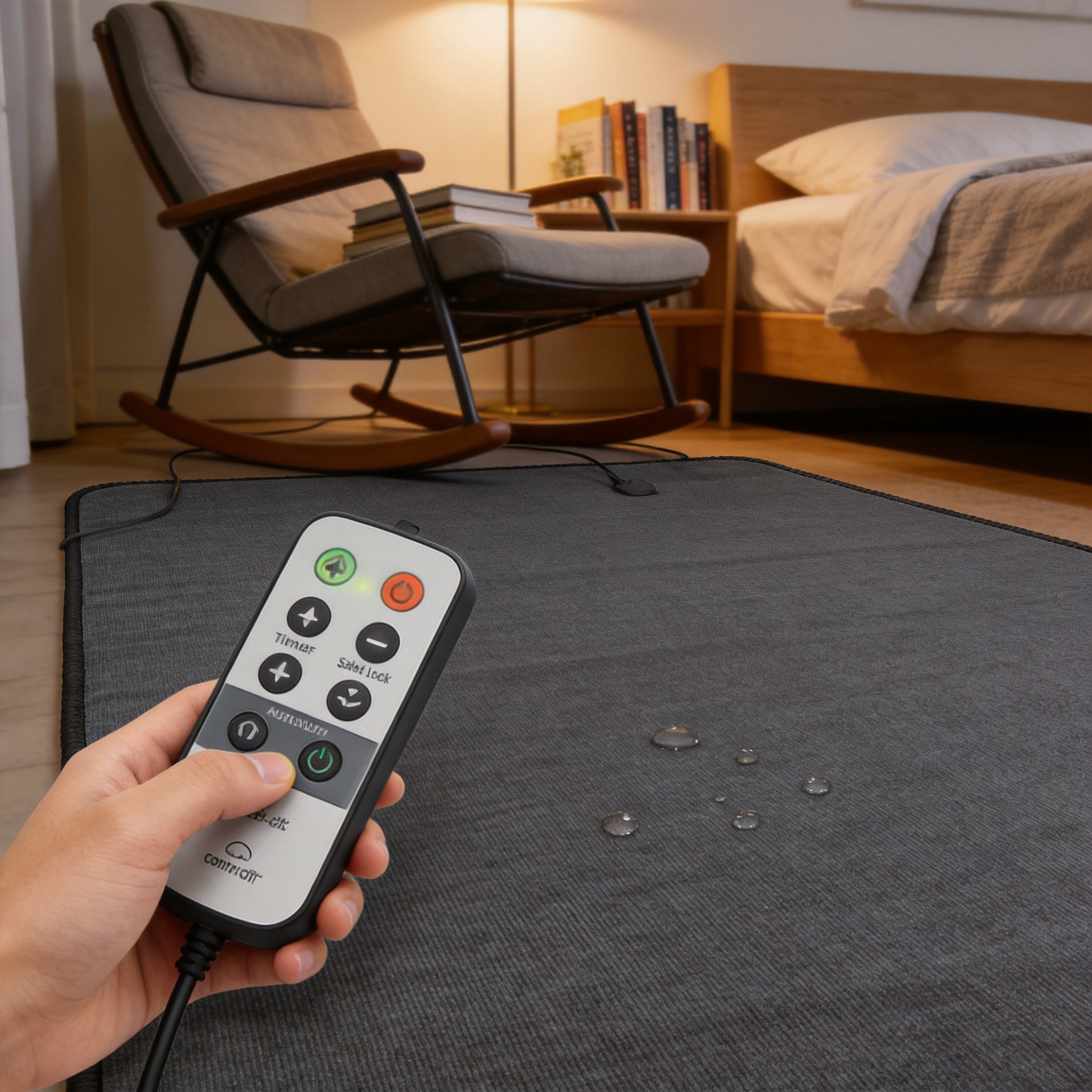
Under-desk heating is one of the product’s most natural applications. Office workers and home-based professionals may remain seated for many hours, and their feet can become cold even when the upper body feels comfortable. Placing the mat beneath the desk provides a dedicated warm zone without taking up the space required by a portable heater.
The 150 × 100 cm dimensions are suitable for many single-user workstations. The mat can be positioned so that the user’s feet rest on the heated area while the chair remains in a comfortable position. The timer can be selected to match a typical work session.
A cold floor can be unpleasant when getting out of bed on winter mornings or during the night. A heated mat placed beside the bed can create a warmer landing area. It may also be positioned near a reading chair or small bedside table, depending on the room layout.
Users should ensure that the mat is placed securely and does not obstruct normal movement. It should not be positioned where it could become trapped beneath heavy furniture or create a trip hazard.
Reading corners, hobby areas, and living-room chairs can benefit from localized warmth. The product can be used beneath a chair or in front of a sofa, giving users a comfortable personal zone without warming the entire room to a higher temperature.
Compact housing often requires appliances that deliver useful performance without occupying excessive floor or storage space. The MT-DN-002 is smaller and more specialized than many room-heating appliances, making it suitable for apartments, studio rooms, dormitory-style accommodation where permitted, and compact offices.
The product may also be used to create a warm area for pets, subject to supervision and suitability for the specific animal. The controller and cable must be protected from chewing or pulling, and the mat should be operated according to the instructions. Pet use should never be assumed to be safe solely because the product is described as a comfort mat.
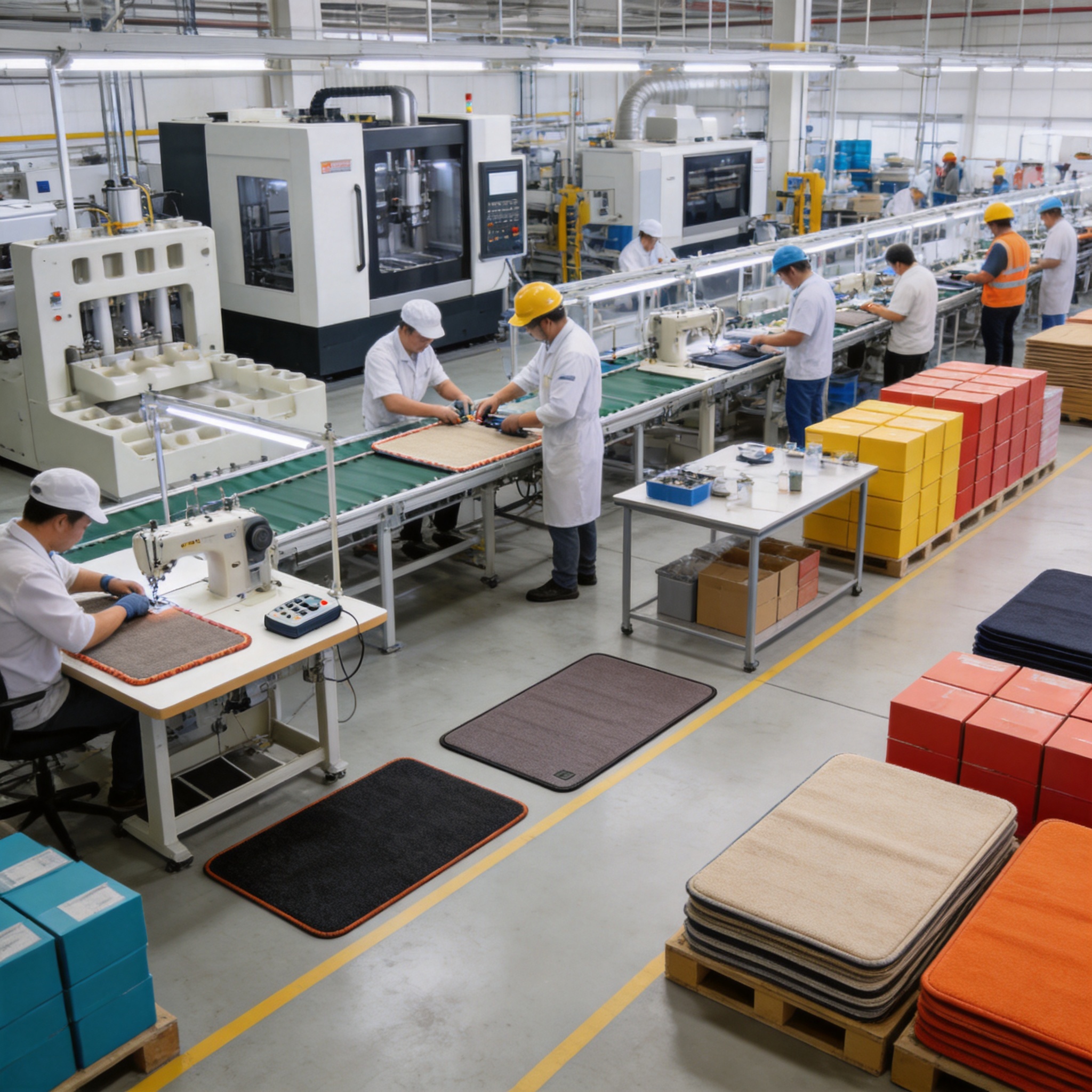
The manufacturer, Ningbo Meeting Industrial&Trading Co., Ltd, was established in 2023 as an integrated manufacturer focused on home appliances and related household products. Its production facilities cover approximately 5,000 square meters and include injection molding, sewing, assembly, and complete appliance manufacturing.
This combination of capabilities is valuable because a heated floor mat requires coordination between soft or flexible materials, molded components, electrical systems, controllers, packaging, and final assembly. A company that can manage several of these processes internally has greater potential to coordinate the product as a complete system rather than treating each part as an isolated purchase.
Injection molding supports the production of selected plastic components, housings, connectors, controller parts, and structural elements. Internal molding capability can help improve consistency in dimensions, surface finish, and component fit.
It can also support faster development of customized parts. For OEM and ODM customers, a new controller housing, logo detail, or structural component may be developed according to an agreed design. The exact scope depends on tooling requirements, order volume, and technical specifications.
Because the product may use fabric materials or fabric-covered surfaces, sewing capability is relevant to the appearance, edge treatment, and durability of the finished mat. Controlled sewing processes can help maintain consistent seams, dimensions, and finishing details across production batches.
Fabric processing also supports customization. Customers may request different surface materials, colors, edge styles, labels, or packaging presentations according to their target market. These options can be particularly important for household products that are displayed in retail stores or online marketplaces.
Assembly is where the heating element, surface layers, controller, wiring, protective components, and final housing must be brought together. A structured assembly process helps ensure that each product follows the same production sequence and inspection requirements.
Complete appliance manufacturing experience can improve communication between engineering, production, purchasing, and quality teams. It may also reduce delays caused by unclear responsibility between separate suppliers.
The company’s stated full-process structure supports control from components to finished products. This does not mean that every part is necessarily manufactured internally, but it indicates an organizational ability to coordinate multiple production stages and manage the finished appliance as a unified product.
For wholesale customers, this can simplify project communication. Instead of discussing material, molding, assembly, packaging, and delivery with several unrelated providers, a buyer can work with one manufacturing partner for the overall project. This may improve efficiency when specifications change during development.
The company maintains teams involved in research and development, product design, production management, and project support. These functions are important for a product category in which comfort, safety, appearance, and manufacturability must be considered together.
Product development begins with the intended use. A compact heating mat for office use may require different material decisions from a mat designed for bedrooms or pet zones. Surface texture, cleaning requirements, controller placement, cable routing, packaging size, and visual design all affect the final product.
Engineering and design teams can work together to balance these requirements. A softer material may improve comfort but require different sewing or cleaning considerations. A thicker protective layer may improve durability but influence heat transfer and product weight. A compact controller may improve appearance but require careful internal component arrangement.
Production management then converts the approved design into repeatable manufacturing procedures. This includes material preparation, component coordination, assembly instructions, inspection points, packing procedures, and delivery scheduling.
Project support is especially relevant for OEM and ODM orders. Buyers may need assistance with logo placement, packaging artwork, product configuration, instruction manuals, electrical specifications, and production timelines. Clear communication at each stage helps reduce misunderstandings and supports more accurate implementation of the customer’s design concept.
The manufacturer offers customization support for size, power, material, surface finish, heating system, controller functions, branding, logo, and packaging. This makes the product suitable not only as a standard catalog item but also as a starting point for market-specific development.
Different markets may require different dimensions. A smaller mat may be preferred for compact workstations, while a larger format may be requested for wider seating areas. Power and heating performance may also need to be adjusted according to the selected size, target environment, and electrical requirements.
Any change to size or power should be evaluated as a complete engineering change. The heating distribution, insulation, wiring, controller capacity, surface temperature, and testing requirements may all be affected.
Customers can explore PVC, fabric, or other approved surface options according to the intended market. Surface finishes may include different textures, colors, patterns, edge treatments, or branding areas. The selected material should be evaluated for durability, cleanability, heat resistance, comfort, and compatibility with the heating system.
The standard product includes four temperature levels and four timer settings. OEM customers may investigate alternative controller layouts, display methods, button designs, lock functions, timer intervals, or user interfaces. Such changes require technical review to ensure that the controller remains compatible with the heating system and applicable safety requirements.
Private-label customers may request logos on the product, controller, label, color box, instruction manual, or shipping carton. Packaging can be adapted to support different retail channels, including physical stores, online marketplaces, project procurement, and distributor sales.
Effective packaging should communicate the product’s primary benefits clearly, including dimensions, temperature control, timer settings, material, safety functions, and intended applications. It should also include accurate electrical information and all required warnings for the destination market.
Quality management for a heated floor mat involves more than checking the appearance of the finished surface. The heating system, electrical connections, controller, insulation, surface materials, water-resistance design, and packaging should all be considered.
Incoming materials should be checked against approved specifications. This may include dimensions, material composition, color, surface finish, wiring, connectors, molded components, and packaging materials. Consistent input materials provide a stronger foundation for stable production.
During assembly, key process points can include heating-element placement, wire routing, controller connection, insulation placement, edge finishing, and surface bonding or sewing. These steps should follow documented procedures to reduce variation between units.
Final inspection may include visual checks, dimensional checks, functional operation, temperature control verification, timer operation, lock function, electrical safety tests, and packaging inspection. The exact test program should be determined according to the product configuration and destination-market requirements.
For wholesale projects, buyers may also request pre-production samples, approval samples, production inspection, carton marking confirmation, and shipment documentation. Maintaining clear records helps both the manufacturer and buyer trace the agreed requirements.
The standard packaging specification is one piece per color box. A color box can help present the product’s features to retail customers while also protecting the mat during handling. The package design may display the product image, dimensions, control options, safety functions, material information, and application examples.
Packaging should be designed according to the folded or rolled condition of the product, the strength requirements of transportation, and the needs of the intended sales channel. Outer cartons should be suitable for warehouse handling and shipment while maintaining clear product identification.
The listed warranty period is one year. Warranty conditions should be defined in the commercial agreement and supported by clear instructions concerning proper use, storage, cleaning, electrical connection, and maintenance. A well-defined warranty process helps distributors respond consistently to customer inquiries.
The minimum order quantity is 1,500 pieces per color. This quantity is suitable for wholesale programs, retail launches, distributor orders, and private-label projects that require sufficient volume for customized production. Buyers should confirm lead time, sample policy, color availability, packaging requirements, payment terms, inspection arrangements, and shipping details before placing an order.
For larger programs, supply planning should account for material procurement, tooling if required, production scheduling, quality inspection, packaging, and transportation. Early confirmation of artwork and technical specifications can reduce delays during the production stage.
The product addresses several broad consumer needs: personal comfort, compact living, workplace warmth, adjustable operation, and practical household design. These needs are relevant across many markets, although electrical specifications, labeling, certifications, and preferred materials may differ by region.
The 100V configuration is particularly relevant to markets that use compatible electrical systems. Buyers serving other voltage regions should discuss whether an alternative electrical configuration is available and confirm all related technical and compliance requirements before production.
The product’s compact format is also suitable for e-commerce. It can be explained through clear dimensions, application photographs, control diagrams, and feature descriptions. The timer, four temperature settings, water-resistant protection, and child lock provide several concrete points for online product comparison.
For physical retailers, the color box and compact format can simplify shelf presentation and inventory handling. For distributors, the product can be positioned as part of a broader household comfort range that includes heating appliances, cooling appliances, and related home-use electrical products.
The manufacturer’s experience in professional exhibitions, including participation in the Tokyo Gift Show, indicates exposure to international product presentation and customer communication. Exhibition participation can help manufacturers understand market preferences, packaging expectations, and emerging household product trends.
Before use, the mat should be unfolded completely and placed flat on a suitable surface. Users should inspect the surface, power cord, controller, plug, and connections for visible damage. The product should not be used if any component appears damaged.
The mat should be kept away from sharp objects, excessive pressure, flames, and unsuitable coverings. It should not be folded or creased during operation. Furniture placed on the mat should be compatible with the manufacturer’s instructions and should not compress the product in a way that affects heat dissipation.
Users should select a temperature level appropriate for their comfort and avoid prolonged direct contact with high temperatures. Children, elderly users, people with reduced temperature sensitivity, and individuals who may not be able to respond normally to heat require special care and supervision.
Cleaning should follow the supplied instructions. The mat should be disconnected from power before cleaning, and electrical components should be protected from moisture. Even with water-resistant protection, users should not assume that every component can be washed, immersed, or exposed to uncontrolled water.
For storage, the product should be clean, dry, and protected from sharp folds or heavy objects. The controller and cord should be stored without excessive bending. Proper care can help preserve the surface, wiring, and heating performance over time.
The product is designed to provide targeted warmth in personal areas such as under desks, beside beds, reading corners, small apartments, and relaxation spaces. It is intended to warm the user’s immediate floor zone rather than heat an entire room.
The mat measures 150 × 100 cm. This size is designed to provide coverage for the feet and lower body while remaining compact enough for personal and limited-space applications.
The product provides four temperature levels: low, medium, high, and high-plus. The approximate ranges are 27°C–32°C, 32°C–37°C, 38°C–44°C, and 50°C–55°C.
The timer includes 3-hour, 6-hour, 9-hour, and 12-hour settings. These options allow users to match operation to work sessions, relaxation periods, or longer periods of occupancy.
The supplied specification identifies IPX7 water-resistant protection. Users should still follow the instructions carefully, keep electrical connections in safe condition, and avoid using the product in ways not approved by the manufacturer.
The product includes a child safety lock intended to help prevent accidental operation or unintended setting changes. Children should still be supervised, and the controller, cord, and mat should be kept out of situations where they could be pulled, chewed, or misused.
OEM and ODM options include adjustments to size, power, materials, surface finishes, heating systems, controller functions, branding, logos, and packaging. All requested changes should be reviewed for technical feasibility and market compliance.
The manufacturer operates approximately 5,000 square meters of production facilities with injection molding, sewing, assembly, and complete appliance manufacturing capabilities. These resources support coordination from components through finished products.
The listed minimum order quantity is 1,500 pieces per color. Buyers should confirm current production conditions, color options, packaging requirements, and lead times for each project.
The listed warranty is one year. Specific warranty coverage, exclusions, claim procedures, and documentation should be confirmed in the commercial agreement.
The product is described as suitable for pet comfort zones, but pet use requires supervision. Cables and controllers should be protected from chewing, and the product should be used only in accordance with the applicable instructions.
Buyers should confirm voltage, plug type, applicable certifications, labeling, safety documentation, packaging artwork, warranty terms, inspection procedures, shipping conditions, and any destination-market requirements before placing a production order.
The MT-DN-002 Safety Waterproof Heating Mat is designed as a practical personal comfort appliance for users who need warmth in a specific area rather than throughout an entire room. Its 150 × 100 cm format provides useful floor coverage while remaining appropriate for desks, bedrooms, reading areas, small apartments, and other compact spaces.
The product combines a 560W heating system with four temperature levels and four timer settings. These functions give users greater control than a basic fixed-output heating pad. Water-resistant protection, a child safety lock, and low EMF design add further value for customers seeking a more feature-complete household heating product.
Its PVC and fabric material options support a balance between durability, cleanability, comfort, and visual customization. The product can be developed for different sales channels through changes to size, power, surface materials, controller functions, branding, and packaging.
The manufacturer’s integrated capabilities are an important part of the product proposition. Injection molding, sewing, assembly, and complete appliance manufacturing support coordinated development and production. Combined with R&D, design, production management, and project support, these resources create a foundation for OEM, ODM, wholesale, and private-label cooperation.
For distributors and retailers, the strongest advantages are the product’s targeted heating concept, compact format, adjustable settings, timer operation, practical surface options, and safety-oriented design. For project customers, the manufacturer’s customization and full-process coordination offer additional flexibility. With correct technical evaluation, responsible use, and market-specific compliance review, this heated floor mat can serve as a versatile addition to household comfort product ranges.
Product Specification Sheet. MT-DN-002 Compact Heated Floor Mat. Supplied technical information covering dimensions, power, voltage, materials, temperature levels, timer settings, water-resistant protection, packaging, warranty, and minimum order quantity.
Product Feature Summary. Safety Waterproof Heating Mat. Supplied information covering applications, heating control, child safety lock, low EMF design, material options, maintenance, and OEM/ODM support.
Manufacturer Company Profile. Ningbo Meeting Industrial&Trading Co., Ltd. Supplied information covering company establishment, production facilities, injection molding, sewing, assembly, appliance manufacturing, research and development, project support, and international exhibition experience.
Household Electrical Heating Product Safety Guidance. General principles for responsible placement, electrical inspection, temperature control, cleaning, storage, supervision, and destination-market compliance.
Water-Resistance Classification Reference. General interpretation of enclosure protection ratings for electrical products, subject to applicable testing standards and product-specific certification.
The way we use our eyes has changed. Between laptops, phones, and tablets, most adults now spend hours each day staring at close-up screens, and the delicate tissue around the eye...
READ MOREPortable cooling fans have become an everyday essential for anyone who wants to stay comfortable when temperatures climb. Whether you are commuting, working outdoors, or simply re...
READ MOREYou unbox your new electric blanket, spread it on the bed, and then stop. Which side goes up? It is one of the most common questions for first-time users, and for good reason. The...
READ MOREThe heated eye mask is good for your eyes in most cases — particularly for people suffering from dry eye disease, meibomian gland dysfunction (MGD), eye fatigue, or poor sleep. Wh...
READ MOREAs households increasingly seek ways to stay comfortable while managing energy costs, the Energy-Efficient Smart Heated Throw Blanket has emerged as a practical solution that blen...
READ MOREFalling asleep quickly and staying asleep through the night depend on more than just a dark, quiet room. Body temperature plays a central, often underappreciated role in the sleep...
READ MORE