English
 日本語
 한국어
 Deutsch
Home > Author > Deng Qiaoling — Overseas Product Sales Supervisor > Temperature-Controlled Heated Eye Mask: A Practical Guide to Comfort, Safety, and Scalable Manufacturing
Content
Modern lifestyles place considerable demands on the eyes. Extended computer use, mobile-device viewing, reading, commuting, shift work, and irregular sleep schedules can all contribute to a feeling of tiredness around the eyes. A heated eye mask offers a convenient way to create a warm, relaxing environment during short breaks, evening routines, and personal-care sessions. However, not every heated eye mask provides the same combination of temperature control, material comfort, timer flexibility, safety, and manufacturing reliability.
The MT-EM-001 soothing temperature-controlled heated eye mask is designed as a practical daily-use product for consumers, retailers, hospitality programs, wellness businesses, and private-label buyers. It combines adjustable warmth, three timer settings, a breathable cotton-blend construction, USB input, and a 5V operating system. These features give the product a balanced position between simple non-heated eye covers and more complicated electrically heated products.
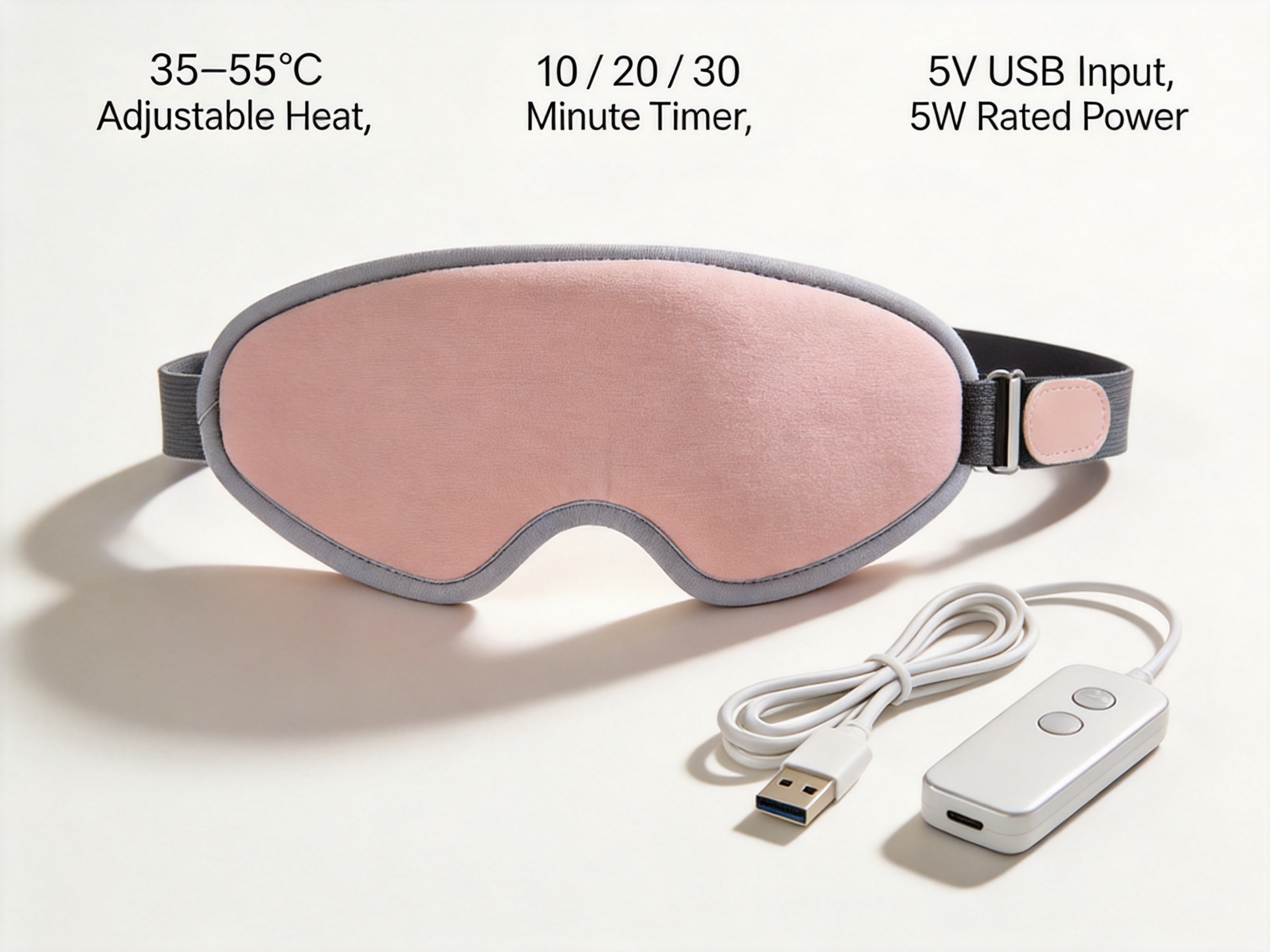
Its design is centered on controlled warmth rather than excessive heat. Users can select a lower or medium temperature for relaxation or a higher setting for a warmer compress experience. The temperature range of 35–55°C supports different preferences while allowing the product to serve multiple use occasions. The three-level timer, with settings of 10, 20, and 30 minutes, helps users establish a defined session without manually monitoring the duration.
For buyers evaluating suppliers, the product is also supported by a manufacturing structure capable of handling injection molding, sewing, assembly, and complete appliance production. This integrated approach can simplify communication, improve process coordination, and support customization for wholesale and private-label projects.
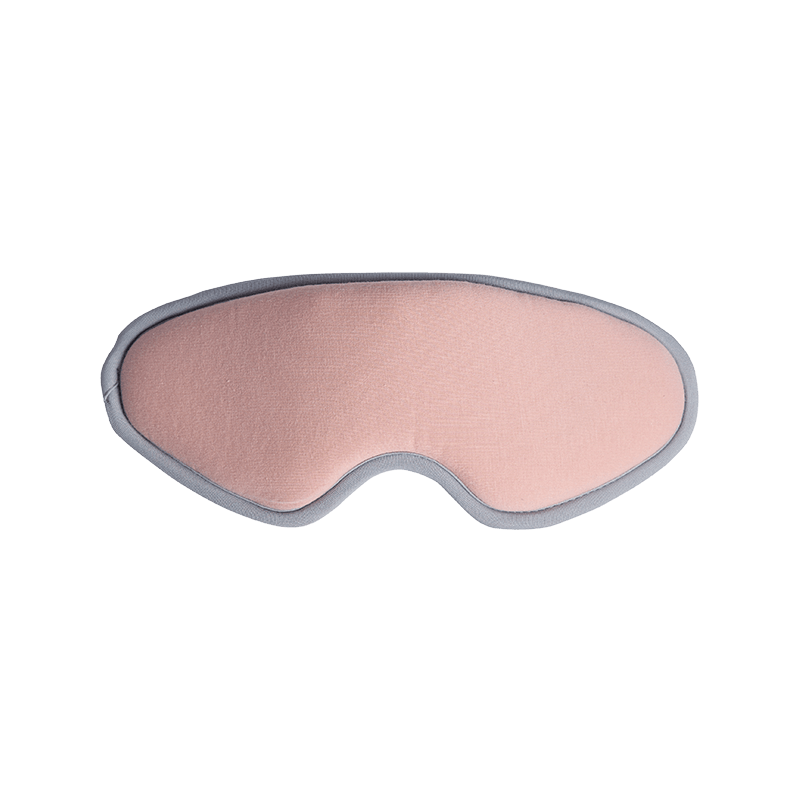
Soothing temperature-controlled heated eye mask
A heated eye mask is a compact personal-care appliance that applies gentle warmth around the eye area while blocking light. The mask format combines two functions: it creates a darker environment that can support relaxation, and it provides controlled heat for a warm-compress experience. The MT-EM-001 is intended for use at home, in offices, while traveling, or in other suitable indoor environments where a USB power source is available.
Unlike disposable steam masks, the MT-EM-001 is designed for repeated use. It does not depend on a single-use chemical heating element. Instead, it receives power through a USB input and produces warmth through an electrically controlled heating system. This reusable structure can be attractive to customers who want a consistent product for regular routines and to businesses seeking a durable item for a product range.
The product operates at 5V and 1A through USB input, with a rated power of 5W. Low-voltage operation is an important part of the product concept because it is compatible with common USB power sources such as adapters, computers, power banks, and other suitable devices. The use of a familiar power interface also reduces the need for specialized chargers in many applications.
The eye mask is made from cotton blends. The material selection is intended to balance softness, wearability, breathability, and manufacturing practicality. During a warm session, fabric comfort is especially important because the mask remains in close contact with the face. A moisture-wicking and breathable surface can help reduce the stuffy feeling that may occur when warm fabric remains against the skin for an extended period.
One of the most important product advantages is the stated operating range of 35–55°C. A broad temperature range gives the user more control than a mask that offers only one fixed heat level. Since personal preferences differ, adjustable warmth can improve the overall usability of the product and reduce the risk that the user finds the mask too cool or too hot.
The 35–45°C range is suitable for gentle relaxation and routine use. Many users may prefer a moderate temperature when wearing the mask during an evening wind-down period, a short break from screen work, or a quiet rest session. This range can create a comfortable sensation without making the mask feel excessively hot.
For retailers, the low-to-medium setting supports a broad customer audience. Customers who are sensitive to heat, first-time users, or people who want a longer relaxation session may appreciate the ability to select a gentler setting. It also gives the product a more approachable entry point than a device marketed only for high-temperature use.
For offices and travel-related applications, a moderate setting may be particularly practical. A user can use the product during a short break without creating the intense sensation associated with a high-heat compress. The combination of moderate warmth and light blocking can help create a personal pause within a busy schedule.
The 45–55°C range is intended for a warmer compress experience and for users who prefer stronger heat. The product information describes this setting as suitable for a therapeutic hot-compress experience aimed at alleviating eye fatigue. It is important to understand that the eye mask is a consumer comfort product and should not be presented as a replacement for professional diagnosis or medical treatment.
High heat should always be used responsibly. Users should follow the product instructions, select a comfortable setting, limit the session to an appropriate duration, and stop using the mask if they experience pain, burning, irritation, dizziness, or unusual discomfort. People with reduced heat sensitivity, certain skin conditions, recent eye procedures, or specific medical concerns should seek professional advice before using a heated product.
From a product-positioning perspective, the high-temperature option gives the MT-EM-001 additional versatility. A competitor product with only mild warmth may be comfortable but less flexible for customers seeking a stronger compress sensation. Conversely, a product that operates only at a high temperature may not be appropriate for all users. A selectable range provides a more balanced solution.
The MT-EM-001 includes three timer settings: 10, 20, and 30 minutes. This feature is simple, but it has considerable practical value. A timer allows the user to select a defined session and reduces the need to watch the clock. It also supports different usage patterns, from a brief reset to a longer relaxation period.
Feature |
Specification |
Practical Benefit |
Temperature range |
35–55°C |
Supports gentle, moderate, and warmer heat preferences |
Timer options |
10, 20, and 30 minutes |
Allows users to select a short, standard, or extended session |
Rated voltage |
5V |
Low-voltage operating design for compatible USB power sources |
Input current |
1A |
Supports a common USB power configuration |
Rated power |
5W |
Compact power requirement for a small personal-care appliance |
Outer material |
Cotton blends |
Designed for a soft, breathable, and comfortable contact surface |
The 10-minute setting can suit a quick break or a first-time user who wants to test the warmth. The 20-minute setting provides a medium-length routine that may work well in the evening or during a scheduled rest period. The 30-minute setting offers a longer session for users who prefer extended relaxation, provided that the temperature and duration remain comfortable.
Compared with products that have no timer, a three-level timer can provide a clearer and more controlled user experience. Compared with highly complicated products that include many controls, the three-setting format is easy to understand. This balance can reduce the learning curve and make the product suitable for a wide range of age groups and usage environments.
The product uses a 5V safe-voltage design and USB input. Low-voltage architecture is a central safety-oriented feature for a wearable heating product. The 5V rating is commonly associated with USB-powered consumer electronics and can make the product easier to integrate into existing household and office power arrangements.
The safety value of a low-voltage design depends on the complete product system, not on voltage alone. Electrical connections, heating elements, insulation, temperature control, wire routing, controller design, strain relief, and quality inspection must all be managed correctly. A reliable manufacturer therefore needs to control the product from component selection through assembly and final testing.
The MT-EM-001 has a rated input of 5V 1A and a rated power of 5W. These specifications provide buyers with a clear starting point for adapter matching, packaging information, user instructions, and product documentation. They can also help distributors explain the product to customers without relying on vague descriptions such as “low energy” or “USB powered.”
Users should operate the mask only with a suitable power source and should not use damaged cables, modified connectors, or unsuitable adapters. The product should be kept dry unless the instructions specifically state otherwise. It should not be folded, crushed, punctured, or used while asleep unless the manufacturer’s instructions expressly allow such use. These precautions are relevant to all electrically heated textile products.
Material comfort is a decisive factor in the success of an eye mask. The product is worn directly against a sensitive facial area, and the user may remain still for up to 30 minutes. If the fabric feels rough, traps moisture, or creates excessive heat, the customer may stop using the product regardless of its electrical performance.
The cotton-blend construction is intended to provide a balance between a familiar soft-touch feel and the durability required for repeated handling. Cotton-blend textiles can also support efficient sewing and assembly processes. Depending on the final specification, the material structure can be adapted for different colors, patterns, branding treatments, or packaging requirements.
The product description emphasizes moisture-wicking and breathability. These characteristics can help reduce the stuffy sensation associated with warm facial wear. When a heated mask is used, warmth and humidity can build up between the textile and the skin. A breathable material can help improve the perceived comfort of the session by allowing moisture management at the contact surface.
Material selection also influences the product’s visual quality. A well-finished textile surface can make the mask look more premium on a retail shelf or in an online product image. Stitching accuracy, edge finishing, strap attachment, controller integration, and fabric alignment all contribute to the customer’s impression of quality.
The heated eye-mask market includes several product types, including simple non-heated sleep masks, disposable warming masks, fixed-temperature electric masks, and advanced products with additional functions. The MT-EM-001 occupies a practical middle position. It provides electrical warmth and adjustable session control without requiring an unnecessarily complex feature set.
A conventional eye mask can block light, but it cannot provide warmth. For customers seeking a warm-compress experience, the MT-EM-001 offers an additional sensory benefit. Its heating function can make the product more suitable for relaxation routines, screen-break programs, wellness kits, and personal-care gift collections.
The reusable electrical design may also offer more consistency than manually warmed towels or improvised compresses. A towel can cool quickly, become inconvenient to reheat, or provide uneven warmth. A controlled heating product is designed to deliver a repeatable experience when used according to its instructions.
Disposable steam masks can be convenient, but they require repeated repurchase and create additional packaging and waste. The MT-EM-001 is designed for repeated use with a USB power source. This can appeal to customers who prefer a reusable personal-care item and to organizations that want a product with longer-term use potential.
Reusable operation can also support brand loyalty. If a customer finds the temperature control and comfort satisfactory, the product may become part of a regular routine rather than a one-time purchase. For wholesale buyers, this creates opportunities for complementary products, replacement accessories, and branded wellness programs.
Fixed-temperature products can be easy to operate, but they may not suit every user. A temperature that feels comfortable to one person may feel too warm or too mild to another. The 35–55°C range gives the MT-EM-001 a wider usability profile and allows customers to adjust the experience based on personal preference and occasion.
Some electrically heated wearable products include numerous settings, wireless controls, mobile applications, or multiple operating modes. These features may be attractive in certain premium segments, but they can also increase cost, training requirements, maintenance needs, and potential points of failure. The MT-EM-001 focuses on the functions most directly related to its purpose: controlled warmth, comfortable material, timer selection, and USB operation.
This focused design can be beneficial for distributors that value dependable operation and straightforward customer communication. It can also support more efficient production and easier quality control because the product architecture remains clearly defined.
The product is suitable for several daily-use scenarios. At home, it can be included in an evening relaxation routine, used during a rest period, or kept as part of a personal-care collection. Its compact form makes it easier to store than larger heating appliances.
In the office, the eye mask can support short breaks after prolonged screen work. A 10-minute setting may be suitable for a scheduled pause, while the moderate temperature range can help create a calmer environment away from bright screens. Employers and wellness coordinators may also consider it for employee-care packages, provided that usage instructions and electrical safety guidance are supplied.
For travel, USB compatibility is a practical feature. Many travelers already carry USB chargers, power banks, or compatible adapters. The product can therefore fit into a travel wellness kit without requiring a dedicated high-voltage heating appliance. Users should check the power source and follow airline, hotel, and transportation rules when carrying or operating any electrical product.
Hotels, spas, beauty businesses, and wellness retailers may use the eye mask as a retail item or as part of a broader customer experience. Its neutral product concept can fit relaxation packages, sleep-related gift sets, seasonal promotions, and corporate gifting programs.
Online sellers may also benefit from the product’s straightforward feature structure. Temperature range, timer choices, material type, voltage, power, and warranty can be communicated clearly in product listings. Clear specifications are particularly important for customers comparing similar USB-powered heating products.
Ningbo Meeting Industrial&Trading Co., Ltd. was established in 2023 as an integrated manufacturer specializing in home appliance development and production. The company operates approximately 5,000 square meters of production facilities and covers several key manufacturing activities, including injection molding, sewing, assembly, and complete appliance manufacturing.
This level of process integration is significant for a product such as a heated eye mask because the item combines textile components, electrical parts, control functions, and finished-product packaging. When multiple stages are managed within a coordinated manufacturing structure, project communication can become more direct. Design adjustments, component coordination, assembly details, and quality requirements can be discussed with teams that understand the full product process.
Injection molding can be used to produce plastic components such as controller housings, cable-related parts, structural pieces, and other formed elements. Consistent molding helps support dimensional accuracy and repeatability. It can also provide opportunities for customized colors, surface finishes, logos, and housing designs.
In-house or closely managed molding capability can reduce dependence on disconnected external processes. It may also make it easier to review a design for manufacturability before mass production. Small details, such as part thickness, snap-fit structure, edge design, and cable exit positioning, can influence assembly efficiency and long-term durability.
Sewing is a fundamental process for a fabric-based wearable product. The quality of seams, fabric alignment, edge finishing, strap attachment, and internal component positioning directly affects comfort and appearance. A professional sewing process should include defined patterns, controlled tolerances, appropriate thread selection, and inspection of finished seams.
For the heated eye mask, sewing must also be coordinated with the electrical heating system. The heating area needs to be positioned consistently, while wires and connectors must be routed in a way that supports user comfort and reduces stress during normal handling. A well-planned assembly sequence can help prevent wrinkles, uneven pressure points, exposed components, and irregular heating performance.
Complete appliance manufacturing involves more than putting parts together. It includes component preparation, wiring, controller installation, textile closure, functional testing, appearance inspection, and packaging. The assembly process must ensure that the heating system is correctly connected and that the outer product maintains its intended shape and comfort.
At the final assembly stage, production teams can check the USB input, timer behavior, temperature settings, power consumption, cable condition, and general appearance. Process documentation helps ensure that operators follow consistent procedures rather than relying solely on personal experience.
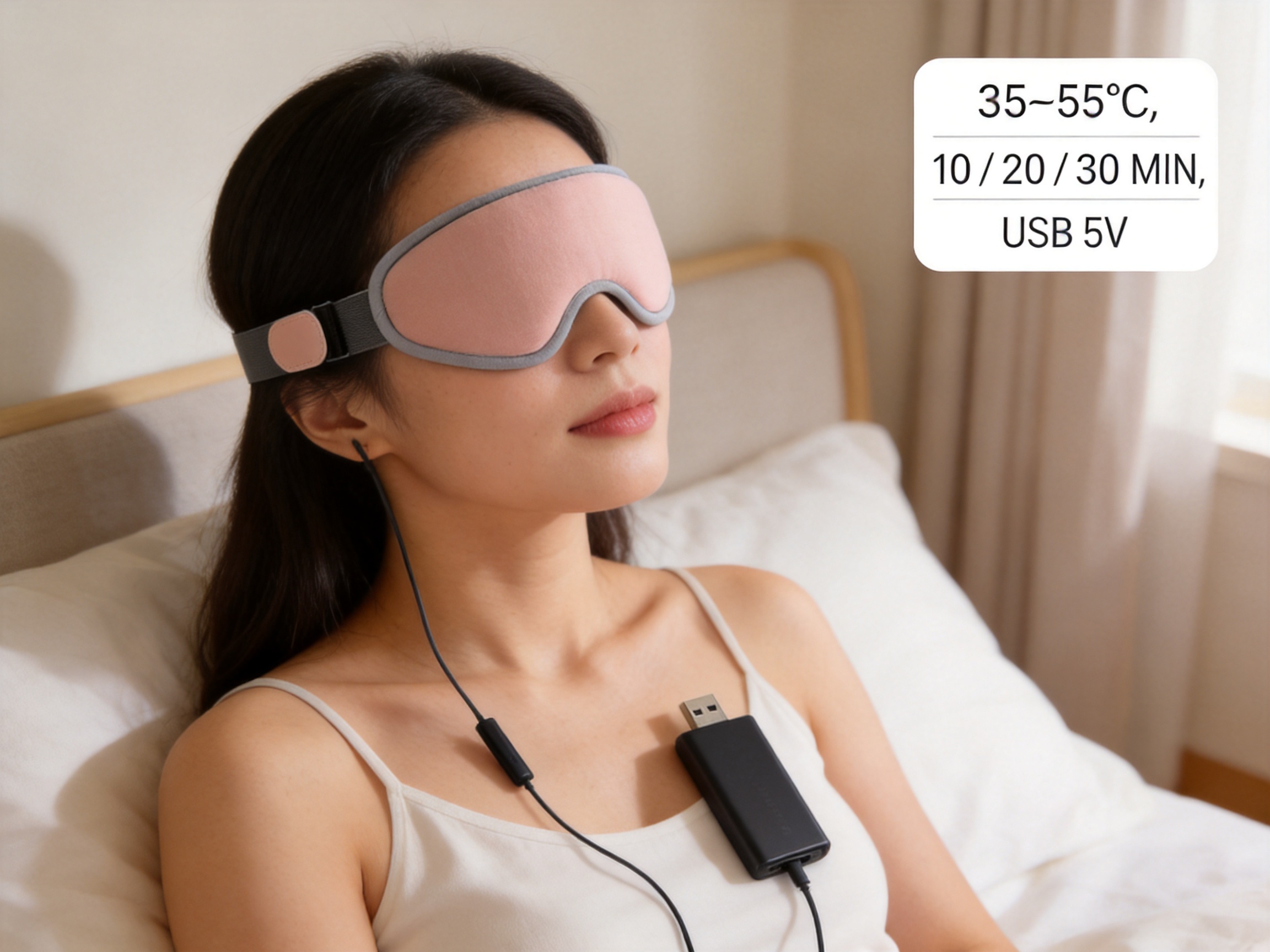
Quality control should address both electrical performance and textile workmanship. A mask can look attractive but fail to deliver stable heat, while an electrically functional unit can still be uncomfortable if its fabric or stitching is poor. A comprehensive inspection program therefore needs to evaluate the complete user experience.
Incoming materials may include fabrics, heating components, wires, connectors, controllers, plastic parts, labels, packaging materials, and accessories. Inspection can verify quantity, dimensions, color, surface condition, electrical characteristics, and compatibility with approved samples.
Fabric inspection is especially important because differences in thickness, softness, stretch, and color can affect both comfort and appearance. Electrical components should be checked against the approved specification so that the final product maintains the intended 5V, 1A, and 5W configuration.
In-process inspection can identify problems before they become difficult or expensive to correct. During sewing, operators can check seam placement, edge finishing, strap attachment, and fabric alignment. During electrical assembly, technicians can verify connections, insulation, wire routing, and controller installation.
In-process checks are valuable because a defect found early may require only a small correction. A defect found after complete packaging may require disassembly, rework, or replacement. Clear work instructions and inspection points can improve production efficiency and reduce avoidable waste.
Functional testing should confirm that the heating eye mask responds correctly to its controls and provides the expected operating behavior. Relevant checks may include power-on performance, timer selection, temperature-level operation, heating consistency, USB connection stability, and automatic shutoff behavior where applicable.
Testing conditions should be defined and repeatable. A manufacturer may establish sample-based or full-unit inspection procedures depending on the order, customer requirements, and applicable standards. Test records can help identify trends and support corrective action if an issue is discovered.
Final appearance inspection can review the textile surface, stitching, cable placement, controller housing, labels, color consistency, and overall cleanliness. Packaging inspection should verify that the product, accessories, instructions, warranty information, and retail box are correctly matched.
The listed packing configuration is one piece per color box. This format can support individual retail presentation and simplify inventory management. Buyers may request additional packaging specifications, such as customized artwork, multilingual instructions, barcode labels, carton markings, or inserts, subject to project confirmation.
The product information lists accessories as “Customization,” indicating that buyers may discuss project-specific requirements. Customization can be considered at several levels. These may include fabric color, external appearance, packaging design, logo application, instruction language, cable configuration, accessory selection, and other approved product details.
Customization should begin with a clear product brief. The buyer should define the target market, intended retail price, preferred material feel, design language, package dimensions, regulatory expectations, and sales channel. A detailed brief helps the manufacturer determine whether the requested change affects tooling, sewing patterns, electrical components, testing procedures, or minimum order quantities.
For brand owners, packaging is often as important as the product itself. A well-designed color box can communicate the product’s main features, such as temperature control, timer settings, USB operation, and reusable construction. Instructional content should explain how to connect the product, select a temperature, use the timer, clean or store the mask, and observe safety precautions.
Customization can also support different market segments. A minimalist neutral design may suit office wellness programs, while a softer color palette may suit beauty and relaxation retailers. A gift-oriented package can emphasize comfort and routine use. A professional-looking package may be more appropriate for hospitality, clinic-adjacent wellness retail, or corporate purchasing.
The stated minimum order quantity is 1,500 pieces per color. This MOQ is relevant for distributors and private-label buyers planning a commercial launch. It allows the manufacturer to organize production, materials, packaging, and color-specific requirements at a scale appropriate for wholesale manufacturing.
Buyers should prepare forecasts before confirming an order. Important planning factors include expected monthly sales, initial launch volume, seasonal demand, retail campaign timing, warehouse capacity, and replenishment schedules. Because color changes may affect the MOQ, buyers should evaluate whether several colors are commercially necessary or whether one core color would be more efficient for the initial release.
Lead times should be confirmed according to the final design, order quantity, packaging requirements, material availability, and production schedule. Buyers should also clarify sample approval procedures, pre-production confirmation, inspection arrangements, shipping terms, carton details, and documentation requirements before mass production begins.
The product includes a one-year warranty. A warranty can provide additional confidence for distributors and end users, but its exact coverage should be documented in the sales agreement and product instructions. Buyers should request clear information about covered defects, claim procedures, required evidence, replacement policies, and exclusions related to misuse, unauthorized modification, liquid damage, or normal wear.
Home appliance projects often involve multiple parties. A company may need to coordinate a designer, textile supplier, plastic-molding supplier, electrical assembler, packaging vendor, and inspection agency. Each additional handoff can introduce communication delays or inconsistencies. An integrated manufacturer can reduce some of this complexity by managing several key processes within one production structure.
Ningbo Meeting’s production capabilities cover product development, injection molding, sewing, assembly, and complete appliance manufacturing. This combination is relevant to the MT-EM-001 because the eye mask requires both soft-goods expertise and electrical-appliance control. A supplier familiar with both areas may be better positioned to resolve design questions involving comfort, heating performance, component placement, and assembly efficiency.
The company’s stated focus includes heating appliances, cooling appliances, and furniture-related household electrical products. This product scope indicates experience across practical home and office applications rather than a focus on a single isolated item. Knowledge gained from related household electrical products can support considerations such as safety, quiet operation, stable performance, user comfort, and durable daily use.
The manufacturer also describes a professional team covering research and development, design, production management, and project support. For an OEM or ODM buyer, this kind of cross-functional support can improve the process of converting an idea into a manufacturable product. It can also help ensure that design concepts are matched with realistic production methods.
Good communication is essential in a product that combines several disciplines. A buyer may have a visual design preference, while the production team must consider heating distribution, component clearance, fabric behavior, cable routing, and packaging dimensions. Early communication can prevent a design from reaching production with unresolved technical problems.
A structured project process may include an initial requirement review, product specification confirmation, sample development, sample testing, design adjustment, packaging approval, pre-production confirmation, mass production, final inspection, and shipment coordination. Each stage should have a clear owner and an agreed approval point.
Project support is also important when customers operate in different countries or regions. Product descriptions, warning labels, power information, user manuals, packaging text, and shipping documentation may need to be adapted for the destination market. Buyers should confirm applicable local requirements and ask the manufacturer to provide available test reports or compliance documentation where relevant.
The company has participated in professional exhibitions such as the Tokyo Gift Show. Exhibition participation can help a manufacturer understand changing product preferences, packaging trends, buyer expectations, and regional market differences. It may also support business communication with customers from multiple countries and regions.
The heated eye mask should be marketed as a comfort, relaxation, and warm-compress product. Product communication should be accurate and should avoid unverified medical promises. Terms such as “helps create a relaxing routine,” “provides adjustable warmth,” and “designed for a warm-compress experience” are generally more responsible than claims that the mask cures medical conditions.
Retail content should clearly explain the temperature range and timer options. Customers should understand that the product is electrically heated, requires a suitable USB power source, and must be used according to the instructions. Safety information should be visible rather than hidden in fine print.
Appropriate warnings may include avoiding use on irritated or damaged skin, checking the product before operation, stopping use if discomfort occurs, keeping electrical components dry, and consulting a qualified professional when there are relevant medical concerns. Exact warnings should be finalized according to the product manual, testing results, and destination-market requirements.
Responsible positioning benefits both consumers and suppliers. It reduces misunderstandings, supports customer satisfaction, and protects the credibility of the retailer. It also allows the product’s genuine advantages—adjustable temperature, timer control, breathable material, USB operation, and low-voltage design—to speak for themselves.
Before use, the customer should inspect the mask, cable, controller, and USB connector for visible damage. The mask should be connected to a suitable 5V USB power source. The user can then select the desired heat level and choose a 10-, 20-, or 30-minute timer setting.
The lowest comfortable temperature should generally be selected first, especially for a new user. The mask should fit comfortably without excessive pressure. The user should remain attentive to the sensation of heat and should stop the session if the temperature becomes uncomfortable.
After use, the product should be disconnected from the power source and stored in a clean, dry location. The mask should not be folded sharply around the heating area or stored under heavy objects. Cleaning instructions should follow the manufacturer’s recommendations because the presence of electrical components may restrict washing methods.
Retailers should provide care information in the package or online listing. Clear guidance can help extend product life and reduce inappropriate use. It can also lower the number of customer-service inquiries related to power connections, timer operation, storage, and cleaning.
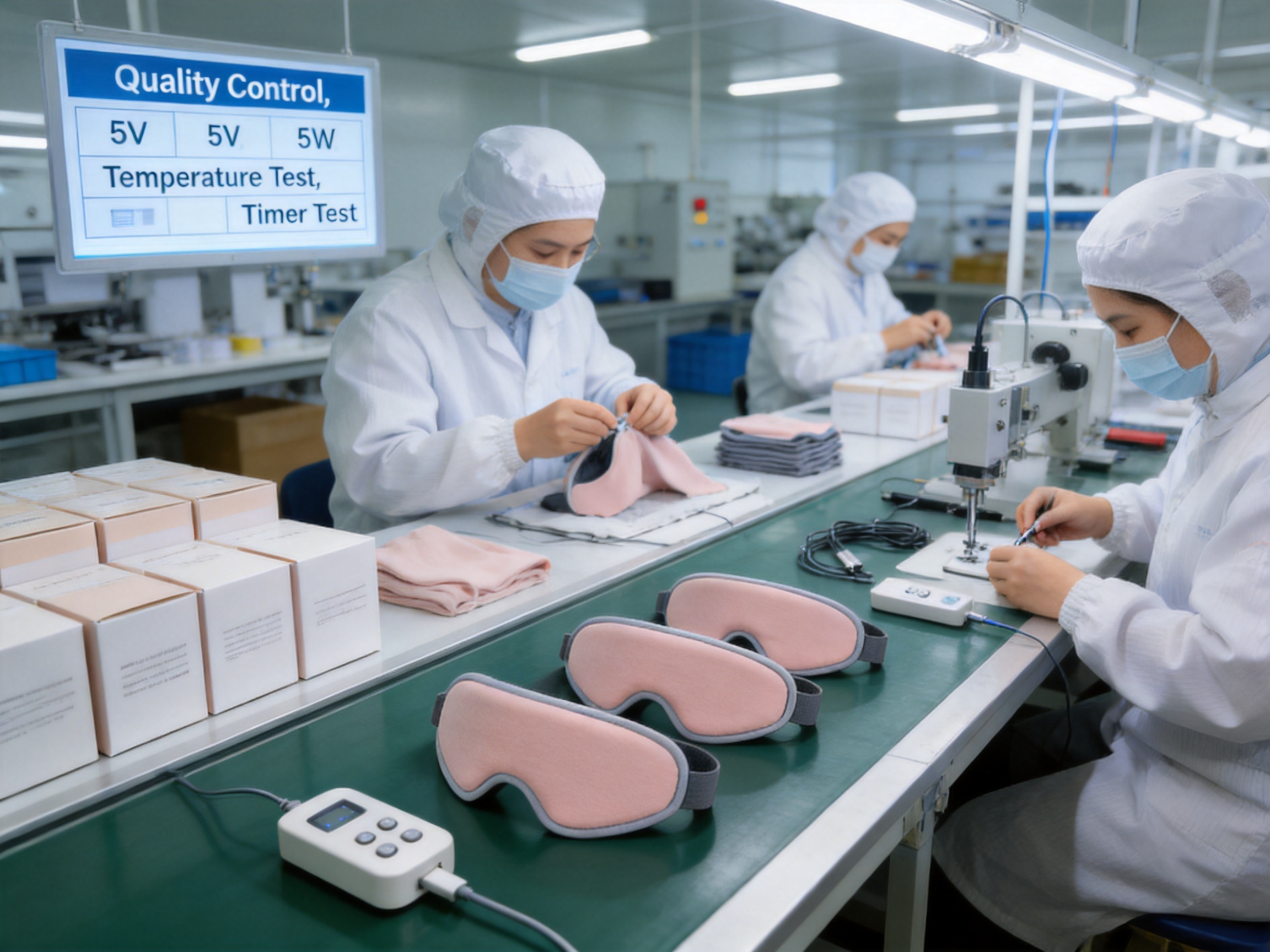
The MT-EM-001 has an operating temperature range of 35–55°C. The lower-to-medium range is intended for gentle relaxation, while the higher range is intended for a warmer compress experience. Users should select a comfortable temperature and follow the product instructions.
The product provides three timer options: 10 minutes, 20 minutes, and 30 minutes. These settings allow users to choose a brief, standard, or longer session according to their preference and routine.
The heated eye mask uses USB input and is rated at 5V 1A with a power rating of 5W. It should be used with a suitable and undamaged USB power source.
The listed specification identifies the product as using USB input, but it does not state that the mask contains a built-in rechargeable battery. Buyers should confirm the final configuration if battery operation is required for a specific project.
The product is made from cotton blends. Its described material features include breathability and moisture-wicking performance intended to improve comfort during heat therapy.
The product is a consumer comfort and warm-compress item. It should not be presented as a substitute for professional medical advice, diagnosis, or treatment. Users with eye conditions, reduced heat sensitivity, recent procedures, or other concerns should seek appropriate professional guidance before use.
Adjustable temperature allows different users to select a warmth level that suits their preference. It also makes the product more versatile for different occasions, such as a short office break, an evening relaxation session, or a warmer compress routine.
The three-level timer keeps operation simple while offering useful flexibility. Users can select 10, 20, or 30 minutes without navigating a complicated control system. A defined session can also reduce the need to monitor the time manually.
The listed MOQ is 1,500 pieces per color. The final order requirements should be confirmed with the manufacturer, especially when custom colors, packaging, accessories, or other modifications are requested.
The product information lists customization as an available accessory or project option. Buyers can discuss design, color, packaging, branding, documentation, and other requirements with the manufacturer. Technical feasibility, tooling, cost, and MOQ may vary according to the requested changes.
The listed warranty period is one year. Buyers should confirm the detailed warranty terms, claim process, coverage, and exclusions before placing a commercial order.
Potential buyers include household-goods distributors, wellness retailers, beauty and relaxation businesses, travel-accessory sellers, office-wellness providers, hospitality groups, corporate-gift suppliers, and private-label brands.
The eye mask combines textile construction, electrical heating, molded components, controls, and packaging. Integrated capabilities in injection molding, sewing, assembly, and appliance manufacturing can simplify coordination and support more consistent product development and production management.
The MT-EM-001 soothing temperature-controlled heated eye mask is designed around the practical needs of repeated daily use. Its main strengths are the 35–55°C adjustable temperature range, three timer choices, breathable cotton-blend material, USB input, 5V operating design, and compact 5W power rating. These features give it a versatile position compared with non-heated masks, disposable warming products, fixed-temperature models, and unnecessarily complex alternatives.
The product’s value also depends on the manufacturing system behind it. Ningbo Meeting Industrial&Trading Co., Ltd. combines product development and production capabilities across injection molding, sewing, assembly, and complete appliance manufacturing. This integrated structure is relevant to a wearable heating appliance because successful production requires coordination between textile comfort, electrical function, component quality, appearance, and packaging.
With a one-year warranty, a listed MOQ of 1,500 pieces per color, and customization support, the product can be considered for wholesale, private-label, corporate, wellness, travel, and retail programs. Buyers should confirm final specifications, testing documentation, packaging requirements, delivery schedules, and warranty conditions before mass production.
For consumers, the key to a positive experience is responsible use: select a comfortable temperature, choose an appropriate timer, use a suitable USB power source, keep the product dry, inspect it before operation, and follow all instructions. For commercial buyers, the key is clear project communication and accurate product positioning. When these elements are managed together, a temperature-controlled heated eye mask can become a useful and marketable addition to a modern home and personal-care product range.
1. Product specification sheet for the MT-EM-001 soothing temperature-controlled heated eye mask.
2. Manufacturer-provided information regarding cotton-blend materials, USB input, 5V operating voltage, 5W power, timer settings, packaging, MOQ, and warranty.
3. Manufacturer-provided company profile covering product development, injection molding, sewing, assembly, appliance manufacturing, and project support.
4. General consumer-product principles for the responsible use of electrically heated textile products.
5. General textile-product considerations concerning breathability, moisture management, seam quality, comfort, and repeated-use durability.
The way we use our eyes has changed. Between laptops, phones, and tablets, most adults now spend hours each day staring at close-up screens, and the delicate tissue around the eye...
READ MOREFalling asleep quickly and staying asleep through the night depend on more than just a dark, quiet room. Body temperature plays a central, often underappreciated role in the sleep...
READ MOREThe heated eye mask is good for your eyes in most cases — particularly for people suffering from dry eye disease, meibomian gland dysfunction (MGD), eye fatigue, or poor sleep. Wh...
READ MOREFew things feel as good at the end of a long day as a warm, gentle hug for your eyes. That is exactly what a steam eye mask delivers. Over the years, we have built heated eye mask...
READ MOREThe first time you wash a heated blanket, the process feels slightly risky. You are placing a product filled with wires into water, and a mistake can shorten its lifespan or damag...
READ MORELayering Is the First Rule of Using a Heated Blanket Last winter, a customer told me his new heated blanket felt cold around his feet. We checked the setup together, and the probl...
READ MORE